The Past-Narrative Healing Guide: Mapping and Rewriting Your Life Story
This guide is an intensive, past-focused narrative healing process designed to help you understand how early experiences shaped your identity, coping strategies, and relationships—and to consciously choose how you want to live now. This is not about diagnosing or reliving pain; it’s about uncovering the logic behind your adaptations and reclaiming authorship of your life story.
Use this as a living document. Move slowly and revisit as your understanding deepens.
How to Use This Guide:
Complete one section per sitting for focus and depth.
Write what happened first, what you felt second, what you decided or concluded last.
Approach your younger self with curiosity and compassion, not judgment.
After each section, ask: What did I learn to do because of this and is it still serving me?
Foundational Belonging & Caregiver Imprints
Mother Wound: Nurture, Safety, and the Feminine
Explore early experiences of care and how they shaped your sense of emotional safety, trust, and relationship to the feminine—both within yourself and others.
Reflect on:
Moments care felt inconsistent, conditional, or emotionally absent
Times you learned to self-soothe, hide feelings, or stay quiet
Experiences of feeling responsible for her emotions or stability
How affection was tied to behavior, mood, or compliance
Early impressions of warmth, vulnerability, or softness as safe or unsafe
Meaning-Making Questions:
What did closeness come to mean to me?
How did this shape my relationship to the feminine—internally and relationally?
How would I like to relate to nurture and receptivity now?
Father Wound: Direction, Authority, and Orientation
Examine how guidance, approval, and limits shaped your sense of competence, power, and direction.
Reflect on:
Early attempts to seek guidance or affirmation
Emotional, physical, or psychological absence
Experiences of criticism, pressure, or comparison
Times you felt forced to mature early or prove capability
Messages received about strength, success, or failure
Meaning-Making Questions:
What did I learn about earning respect or worth?
How did I adapt to survive or succeed?
What kind of authority or leadership do I want to embody now?
2. Early Social Belonging & Identity Formation
Friendships and Early Social Roles
Explore how your first experiences of inclusion and exclusion shaped your social identity.
Reflect on:
Memories of rejection, invisibility, or being overlooked
Attempts to fit in that didn’t succeed
Roles adopted to gain acceptance (helper, achiever, clown, observer, loner)
Moments of being tolerated rather than chosen
Early fears of being unwanted or excluded
Meaning-Making Questions:
What role felt safest to play?
How does that role show up today?
Who could I be if belonging didn’t have to be earned?
School, Peers, and Comparison
This is where identity often hardened through labels and performance.
Reflect on:
Academic, athletic, or social comparisons that hurt
Labels applied by teachers, peers, or family
Moments of feeling “behind,” defective, or exposed
Times you hid or overused parts of yourself
Early definitions of success or failure
Meaning-Making Questions:
What kind of person did I feel I had to be?
What did I promise myself I would never be?
How do these promises still influence my life?
3. Body, Nervous System, and Difference
Embodied Difference and Sensitivity
Examine how your physical, neurological, and emotional traits shaped identity, resilience, and coping.
Reflect on:
Physical differences, injuries, or illnesses
Emotional intensity, anxiety, or shutdown
Sensory sensitivities or neurodivergence
Adult responses—dismissal, overreaction, or neglect
How your body influenced how you engaged with the world
Meaning-Making Questions:
What story did I create about my body or nervous system?
What strengths emerged from my adaptations?
How could I work with my system instead of against it?
4. Intimacy and Attachment in Adulthood
Romantic and Sexual Development
Understand how early beliefs about worth and desire influenced intimacy.
Reflect on:
Early crushes, rejections, or longings
Shame, secrecy, or confusion around attraction
Being desired for reasons other than who you are
Moments intimacy felt unsafe or overwhelming
Messages about sex, power, or connection
Meaning-Making Questions:
What did desire teach me about my worth?
How did I learn to protect myself in intimacy?
What kind of intimacy do I want now?
Adult Relationship Patterns
Examine recurring relational dynamics.
Reflect on:
Betrayals, abandonment, or emotional withdrawal
Patterns of overgiving, controlling, or withdrawing
Moments of feeling chosen versus tolerated
Repeating conflicts or familiar pain
Dynamics that echo early relationships
Meaning-Making Questions:
What story keeps repeating?
What am I still trying to resolve?
What would it take to relate differently now?
5. Meaning, Identity, and Re-Authoring
Core Beliefs About Self
Identify beliefs that have guided your life.
Reflect on:
Statements you live by (e.g., “I have to earn love,” “Rest is unsafe”)
How these beliefs shaped choices and relationships
When these beliefs first made sense
Ways they protected you
Ways they now limit you
Core Question:
Which beliefs deserve to guide me forward—and which can I release?
Coping and Striving Patterns
Examine survival strategies that became identity.
Reflect on:
Achievement, control, independence, service, detachment, humor, intensity
Strategies that once protected you
Where they now limit growth
Which behaviors have become default rather than choice
How they show up in relationships and self-care
Core Questions:
What did these patterns protect me from?
Which now constrain me?
What could I practice instead?
Re-Authoring Your Story
For each major wound or adaptation, briefly note:
What it protected you from
What it cost you
What you want to keep
What you are ready to release
Core Question:
How can I write the next chapter of my life with conscious choice and dignity?
Final Frame
This work is not about digging endlessly into pain…
It is about reclaiming dignity, understanding your adaptations, and choosing how you move forward.
You adapted with intelligence and courage.
Now you get to author who you become next.
Depression 101: Understanding and Working With It
Depression Isn’t Weakness.
Depression isn’t a moral failing, laziness, or a flaw in character.
It’s a mood, a bigger pattern of nervous system shutdown signaling that something in life feels stuck, unsafe, or disconnected.
That heavy chest, low energy, and sluggish motivation aren’t random….
They’re your body saying, “Pay attention. Something needs to change.”
From a Polyvagal perspective, depressive moods arise when the nervous system settles into a sustained shutdown state. The social engagement system withdraws, motivation dips, and energy is conserved.
This is protective: when life feels unpredictable or overwhelming, your system retreats to keep you safe…but the cost is feeling numb, disconnected, or stuck.
When The Nervous System Shuts Down
Depression often isn’t triggered by a single catastrophic event. More commonly, it emerges quietly through the accumulation of everyday stress that never fully resolves. To understand this, it helps to look at how an ordinary day can gradually overwhelm the nervous system and lead to shutdown.
You wake up already tired, not fully rested. Your phone has notifications waiting before you’re out of bed. You skip breakfast because you’re running late. Traffic is heavier than usual. At work, a vague email arrives with no clear expectations. Your body stays slightly braced all morning with shallow breathing, a tight chest, and tension in your jaw. Nothing dramatic happens, but your nervous system remains in low-grade threat without relief.
By early afternoon, the system reaches its limit. A small stressor lands, a minor criticism, a delayed response, a change of plans, and instead of mobilizing, everything drops. Motivation fades. Thinking slows. Emotional flatness sets in. The pull is toward withdrawal, scrolling, sleep, or isolation.
What looks like depression or apathy from the outside is often a nervous system conserving energy after prolonged strain.
Prelude to Depressive Episodes
Childhood experiences and early parenting can shape these reactive patterns. Repeated exposure to misattuned care, neglect, or relational inconsistency can sensitize the nervous system toward withdrawal or freeze under stress.
Significant life events such as loss, illness, or trauma can reinforce the same response.
Over time, these automatic shutdown responses can become familiar, organizing mood, energy, and motivation in ways that resemble depression. Most people respond by withdrawing or distracting themselves, which often deepens the mood. A more effective approach is to notice what is happening, understand the pattern without self-judgment, and experiment with the kinds of stimulation that support the nervous system rather than overwhelm it.
How to work with depressive moods:
1. Name it. Label what you’re feeling. Don’t just say, “I’m depressed.” Identify specific thoughts, losses, or frustrations. Naming the mood gives your mind and body clarity and starts to move you out of automatic shutdown.
2. Break it down. Depression feels like a mountain. Identify small, actionable steps—movement, connection, or meaningful activity—that signal safety and progress to your nervous system. Small wins matter.
3. Move and connect. Your nervous system is like Goldilocks’ porridge: too little stimulation, too much, or just right. Experiment to find what calms or energizes you. Walk, stretch, dance, reach out to safe people, or engage in creative work. The goal isn’t perfection—it’s “just right” for your current state. These are neural recalibration tools.
4. Use it as feedback. Depressive moods point to areas of life that are misaligned with your values, goals, or needs. Notice what’s missing, explore meaning, and take small steps toward purpose and connection.
The Bottom Line…
Depressive moods are not weakness—they’re a signal from your nervous system and life history. Pay attention, experiment with movement and social connection until you find the “just right” stimulation, break down what matters, and take deliberate steps. Your mood is a compass—use it to recalibrate, reconnect, and reclaim your energy and purpose.
Anxiety 101: How to Use It to Your Advantage
Anxiety Isn’t the Enemy.
Let’s get one thing straight: anxiety isn’t a flaw, a chemical imbalance, or a sign that you’re weak. It’s your body and mind sending a very clear message: something in your life feels uncertain, risky, or unresolved. That racing heart, tight chest, or restless energy? That’s your nervous system kicking in, saying, “Pay attention. Something matters here.”
From a Polyvagal perspective, anxiety happens when your nervous system senses threat and shifts out of its safe, social state. Your body goes into high alert (fight/flight) or shuts down (freeze), even if there’s no immediate danger. These reactions are automatic and protective—they’re designed to keep you alive and alert—but they can feel overwhelming if you don’t understand what’s happening.
Most people react the wrong way: they ignore it, push it down, or scroll endlessly through distractions. That’s like ignoring a flashing check engine light on your car. It won’t go away, and it might get worse. The smarter move is to face it head-on.
Here’s how to work with it:
1. Name it. Get specific. Don’t just say “I’m anxious.” What exactly is making you feel off? Writing it down or speaking it aloud gives your nervous system a chance to shift from chaos toward clarity.
2. Break it down. Anxiety explodes when we look at the whole mountain instead of the steps. Take the big, scary unknown and divide it into pieces you can actually influence. One step at a time beats paralysis every single time.
3. Act on it. Movement is medicine. When your body senses you’re taking action, even small steps, your nervous system recalibrates toward safety. Avoidance only feeds anxiety. Action—deliberate, intentional action—is the antidote.
4. Use it. Shift your perspective: anxiety isn’t something to hate; it’s a signal from your nervous system guiding you. When you pay attention, adjust, and move, it becomes a tool for clarity, preparation, and growth.
Caveat: Anxious Attachment and the Deeper Patterns
For many, anxiety isn’t just about situational stress—it’s tied to relational patterns, especially anxious attachment. People with this attachment style experience heightened vigilance and fear of rejection in close relationships, which can amplify everyday anxiety signals. This is where an Adlerian lens becomes essential: anxiety isn’t a personal flaw—it’s a signal pointing to beliefs, patterns, and goals that need adjustment. By exploring early experiences, relational scripts, and life goals, you can shift these patterns, develop a stronger sense of agency, and reduce the intensity of automatic anxious reactions.
Bottom line: anxiety is not your enemy—it’s a compass. It’s your nervous system saying, “Something matters. Pay attention, adjust, act.” By understanding your nervous system, your attachment patterns, and your life goals, you can use anxiety as a tool to live more deliberately, fully, and powerfully.
Understanding Yourself Through the Big Five Personality Traits
When it comes to understanding human behavior, the Big Five personality traits are one of the most widely accepted models in modern psychology for describing the major dimensions of personality. Unlike rigid “types,” the Big Five describes broad tendencies that exist on a continuum, meaning everyone has some of each trait in varying degrees. These traits help explain patterns in how you think, feel, and behave—and they’re useful for understanding yourself in relationships, career choices, and everyday life.
To explore your own Big Five personality profile, you can take a free assessment at: https://bigfive-test.com/.
Once you have your results, you can reflect on them independently, process them with a coach, or even share them with a partner to deepen mutual understanding. A simple way to remember them is the acronym OCEAN:
O – Openness to Experience
C – Conscientiousness
E – Extraversion
A – Agreeableness
N – Neuroticism
Unlike labels or pop-psychology types, the Big Five describe broad dimensions of personality that everyone has to varying degrees. Knowing where you fall on each trait can help you understand your behaviors, identify interests, and navigate relationships—all without pathologizing or judging yourself.
1. Openness
Openness reflects how much you seek out new experiences, ideas, and ways of thinking. People who score higher in openness tend to enjoy creativity, abstract thought, and novelty. Those who score lower often find comfort in routine, tradition, and concrete facts. This trait influences how you approach the world—whether you’re energized by discovery or grounded in the familiar. Simply Psychology
Subtraits:
Imagination – How vivid and creative your inner world tends to be.
Aesthetic – Your appreciation for beauty, art, and sensory experiences.
Emotionality – Awareness of your own emotions and emotional depth.
Adventure – Desire for variety, change, and exploration.
Intellect – Interest in ideas, learning, and intellectual challenge.
Liberalism – Openness to new values, unconventional perspectives, and change.
Understanding openness can help clarify whether you’re drawn to explorative work and experiences or whether you thrive in environments with clear structure and predictable rhythms.
2. Conscientiousness
Conscientiousness measures how organized, dependable, and disciplined you tend to be. Individuals high in conscientiousness generally set goals, plan ahead, and follow through. Those lower in this trait may prefer flexibility, spontaneity, or adapting as situations unfold. This dimension is strongly linked with work performance and reliability. Cleveland Clinic
Subtraits:
Competence – Confidence in your ability to get things done.
Order – Preference for neatness, schedules, and structure.
Dutifulness – Commitment to responsibilities and ethical standards.
Achievement – Motivation to excel and accomplish long‑term goals.
Self‑Discipline – Ability to stay focused and finish tasks.
Cautiousness – Deliberate decision‑making and thoughtful risk assessment.
Understanding your conscientiousness helps explain why you might thrive in organized, goal‑oriented roles—or prefer environments that allow for rapid adaptation and creative freedom.
3. Extraversion
Extraversion describes how much you gain energy from the outer world of people, activity, and external stimulation. People higher in extraversion enjoy social connection, lively interactions, and enthusiasm in their environments. Those lower in extraversion (sometimes called introverts) may find meaning in deeper one‑on‑one interactions, quiet reflection, or solitary work.
Subtraits:
Friendliness – Warmth and ease in forming social bonds.
Gregariousness – Enjoyment of social gatherings and group environments.
Assertiveness – Comfort with expressing opinions and leading interactions.
Activity – Overall pace, energy level, and engagement with life.
Excitement – Desire for stimulation, thrill, and novelty.
Cheerfulness – Tendency toward positive emotion and enthusiasm.
Your extraversion profile can inform how you balance interaction with rest, structure social commitments, and choose environments that match your energy levels.
4. Agreeableness
Agreeableness reflects how much you prioritize harmony, compassion, and cooperation in relationships. High agreeableness often means empathy and collaboration come easily; lower agreeableness can involve candid directness, analytical independence, or a focus on optimization over harmony. Both ends are valid ways of engaging with others—it’s about understanding your relational preferences. bigfive.ly
Subtraits:
Trust – Belief in others’ good intentions.
Morality – Straightforwardness and honesty in interactions.
Altruism – Willingness to help and support others.
Cooperation – Preference for teamwork and problem‑solving.
Modesty – Comfort with humility and low self‑focus.
Sympathy – Emotional care and attunement toward others.
Agreeableness insights can be especially helpful in navigating friendships, partnerships, and workplace collaboration with clarity and empathy.
5. Neuroticism
Neuroticism measures emotional sensitivity and reactivity. Higher scores indicate a stronger tendency to experience stress, worry, or negative emotions. Lower scores reflect emotional steadiness and resilience. Neither pole is inherently “better”—they index how you typically respond to stress and emotional stimuli, which can inform coping strategies. The Berkeley Well-Being Institute
Subtraits & What They Mean:
Anxiety – Likelihood of feeling nervous or tense.
Anger – Propensity toward irritation or frustration under stress.
Depression – Tendency to feel down, sad, or discouraged.
Self‑Consciousness – Sensitivity to others’ perceptions and social evaluation.
Immoderation – Difficulty resisting impulses or temptations.
Vulnerability – Susceptibility to stress and feeling overwhelmed.
Understanding neuroticism helps you recognize emotional patterns and build resilience skills that fit your natural style.
How the Big Five Helps You (Without Pathologizing)
The Big Five isn’t about labeling who you are as fixed or “good/bad”—it’s an evidence‑based map of tendencies that helps you understand:
Your interests: Which environments, work, and hobbies resonate with your natural inclinations.
Your behaviors: Patterns in how you respond to stress, plan tasks, or engage socially.
Your relationships: How differences in personality show up in communication, conflict, and collaboration.
After taking the test at https://bigfive-test.com/, you can reflect on your results personally—breaking down both broad traits and subtraits—or bring them into a session to explore how they show up in your life, work, and relationships.
A Final Note
Personality is nuanced and shaped by both biology and experience, but it’s not destiny. Your Big Five profile describes tendencies, not absolutes, and can evolve as you grow, learn, and intentionally shape your behavior. Using this framework can increase self‑awareness, reduce misunderstandings, and support more mindful choices in life and relationships.
Creativity as a Compass: A Holistic Approach to Reclaiming Your Creative Life
Creativity is often misunderstood as a talent reserved for artists or an elusive “muse.” From an Adlerian perspective, creativity is an expression of striving toward purpose and contributing to the world; it’s how we individuate and assert our unique value. Jungians add that creative expression is a dialogue with the unconscious, bringing archetypes, shadow material, and unspoken parts of the self into conscious form. Viewed holistically, creativity is less about output and more about alignment with your whole self—psychologically, emotionally, socially, and energetically.
Energy and Emotional Attunement
At its core, creativity demands energy, and emotional attunement is a key part of sustaining it. Artists often feel blocked when overwhelmed, anxious, or disconnected from their emotions. Emotional awareness allows you to notice when energy is high and creative work will flow, or when it’s low and replenishment is needed. Regulation practices—breathwork, micro-breaks, or movement—help maintain productive energy without demanding a “perfect” headspace. By cultivating attunement and self-compassion, artists can navigate emotional ups and downs without harsh self-judgment, preserving resilience for sustained creative engagement.
Common Blocks: Boundaries and Assertiveness
A major drain on creativity comes from overcommitment and difficulty saying no. Boundaries protect both emotional and physical energy. Assertiveness isn’t confrontation—it’s creating space to work in conditions that support inspiration and focus. Evaluating commitments through energy, purpose, and personal value allows creative individuals to safeguard time for meaningful work.
Social Learning and Creative Inspiration
Creativity is relational as well as personal. Mentors, peers, and exposure to other artists provide inspiration, guidance, and accountability. Observing what has worked in your own past or in the routines of successful artists offers practical insight into sustaining a creative practice. Social connection fuels creativity by providing perspective, challenge, and encouragement.
Self-Knowing, Purpose, and Contribution
True creative expression grows from self-knowledge. Understanding your values, non-negotiables, and unique perspective allows your work to feel meaningful rather than performative. Creativity reflects both your internal world and your contribution to others. Adlerian theory reminds us that purpose is rooted in contribution: what you create expresses the gifts only you can bring.
Holistic Practices to Support Creativity
Supporting creativity requires attention to mind, body, emotions, environment, and social context. Practices include:
Micro-projects: Low-stakes creative work that rebuilds flow and confidence.
Movement and breathwork: Restores energy and emotional balance.
Reflection and journaling: Integrates emotional insights and tracks creative priorities.
Boundaries around time and energy: Saying no to protect creative space.
Social engagement: Mentors, peers, performances, and exposure to other artists for inspiration and learning.
Emotional attunement: Checking in with your mood and energy, practicing self-compassion when creativity ebbs, and regulating emotions to navigate ups and downs without self-judgment.
Creativity is not a talent to be mined; it is a practice to be cultivated. When approached holistically—through energy management, emotional attunement, boundaries, social learning, self-knowledge, and integrative practices—it becomes a mirror of who you are and a tool for contributing to the world in ways only you can.
Fear Setting: How to Be Courageous
Tim Ferriss created the “fear-setting” exercise by adapting the ancient Stoic practice of premeditatio malorum—literally, the premeditation of evils. It’s a tool to help you define, prevent, and repair potential negative outcomes so fear doesn’t paralyze you and you can make decisions more confidently. If you’re hesitating on a big move or putting something off because the unknown feels scary, this exercise is your antidote. Grab a pen, brain dump your answers, and don’t edit yourself. Thinking endlessly won’t get you anywhere—write fast, write messy, and aim for volume. Spend a few minutes on each question, and watch clarity and courage emerge on the page.
1. Define Your Nightmare
What are you putting off out of fear?
What is the absolute worst that could happen if you did what you’re considering?
What doubts, fears, and “what-ifs” pop up as you consider the big changes you can—or need—to make?
Envision them in painstaking detail. Would it be the end of your life?
What would the permanent impact be, if any, on a scale of 1–10?
Are these things really permanent? How likely is it that they would actually happen?
2. Repair / Respond
What steps could you take to repair the damage or get things back on track, even temporarily?
How could you regain control? Chances are, it’s easier than you imagine.
3. Outcomes or Benefits
Whether temporary, permanent, internal, or external—what might be the benefits of attempting or partially succeeding?
4. Cost of Inaction
What is it costing you—financially, emotionally, physically—to postpone action?
Measure the cost of inaction in real terms. How will you feel allowing circumstances to impose themselves, and having allowed 6 months, 12 months, or 3 years of your finite life to pass doing something unfulfilling?
Time Horizons:
6 Months:
12 Months:
3 Years:
5. What Are You Waiting For?
Is it better to delay by weeks or months to be “fully prepared”?
Or is it better to start right now with little to no preparation?
If you cannot answer this without appealing to the idea of “good timing,” the answer is simple: you’re afraid—just like the rest of the world.
Measure the cost of inaction, realize the unlikelihood and repairability of most missteps, and develop the most important habit of those who excel and enjoy life: action.
Burnout Recovery Is Performance Recovery
Rest isn’t weak. It’s strategic.
If you’re feeling tapped out, worn down, or stuck in survival mode—you’re not alone. Burnout isn’t a failure. It’s a signal. It’s your body and mind telling you that your system needs recalibration, not more pushing. High performers understand this: they don’t wait for collapse—they plan recovery.
Athletes Don’t Just Train—They Recover
Take LeBron James. Reports suggest he spends over $1.5 million a year on recovery—sleep, massage, cryotherapy, personal chefs, recovery coaches. He’s not just coasting on talent. He prioritizes rest because performance depends on it.
Or consider East African long-distance runners, some of the most dominant endurance athletes in the world. Many nap 2–3 times a day, building their training schedules around rest. Why? Because bodies—and minds—cannot adapt, grow, or perform without downtime.
These elite performers know what most of us forget: growth happens during recovery, not during the grind.
Rest Feels Hard When You’ve Ignored the Signals
If slowing down feels impossible, you’re not broken—you’re conditioned. When your need for rest has been ignored for months or years, your nervous system can get stuck in “on” mode. Rest might feel unsafe, unfamiliar, or even guilt-inducing.
You might notice:
Restlessness or anxiety when you stop moving
Feeling like you have to “earn” rest through productivity
Emotional flooding the moment you finally pause
This is your body protecting you the only way it knows how: by staying in motion. But what helped you survive won’t help you heal. You can relearn how to rest—bit by bit.
Recovery Isn’t Optional—It’s Foundational
If you’re trying to work, parent, create, or lead while burnt out, think like an athlete:
Sleep is sacred. 7–9 hours minimum, plus naps if you’re depleted.
Rest days are non-negotiable. Your nervous system needs time to regulate.
Nutrition, hydration, and movement are part of healing, not bonuses.
Mental rest matters. Boundaries, unplugging, saying “no,” and unlearning hustle-guilt are critical.
What Recovery Might Look Like For You
Blocking off a full weekend to be unproductive—on purpose
Taking 20-minute naps, even if it feels “lazy”
Eating real food at regular intervals
Walking without your phone
Saying no to just one more obligation
Asking for help
You don’t push through burnout. You recover from it.
One line to remember: You can’t outwork your nervous system.
How High-Performers Actually Rest
Why Rest Matters
Recovery is a critical part of mental and physical performance. Elite athletes like LeBron James structure their lifestyle around sleep, nutrition, and recovery. Experts like Andrew Huberman emphasize deliberate rest practices such as NSDR and pre-performance naps to improve cognitive focus, emotional regulation, and learning. Many elite endurance athletes schedule multiple rest or nap sessions per day, combined with stretching or mobility work, to maximize performance and prevent burnout. Rest enhances mental clarity, physical recovery, and baseline dopamine—supporting motivation, resilience, and long-term sustainability.
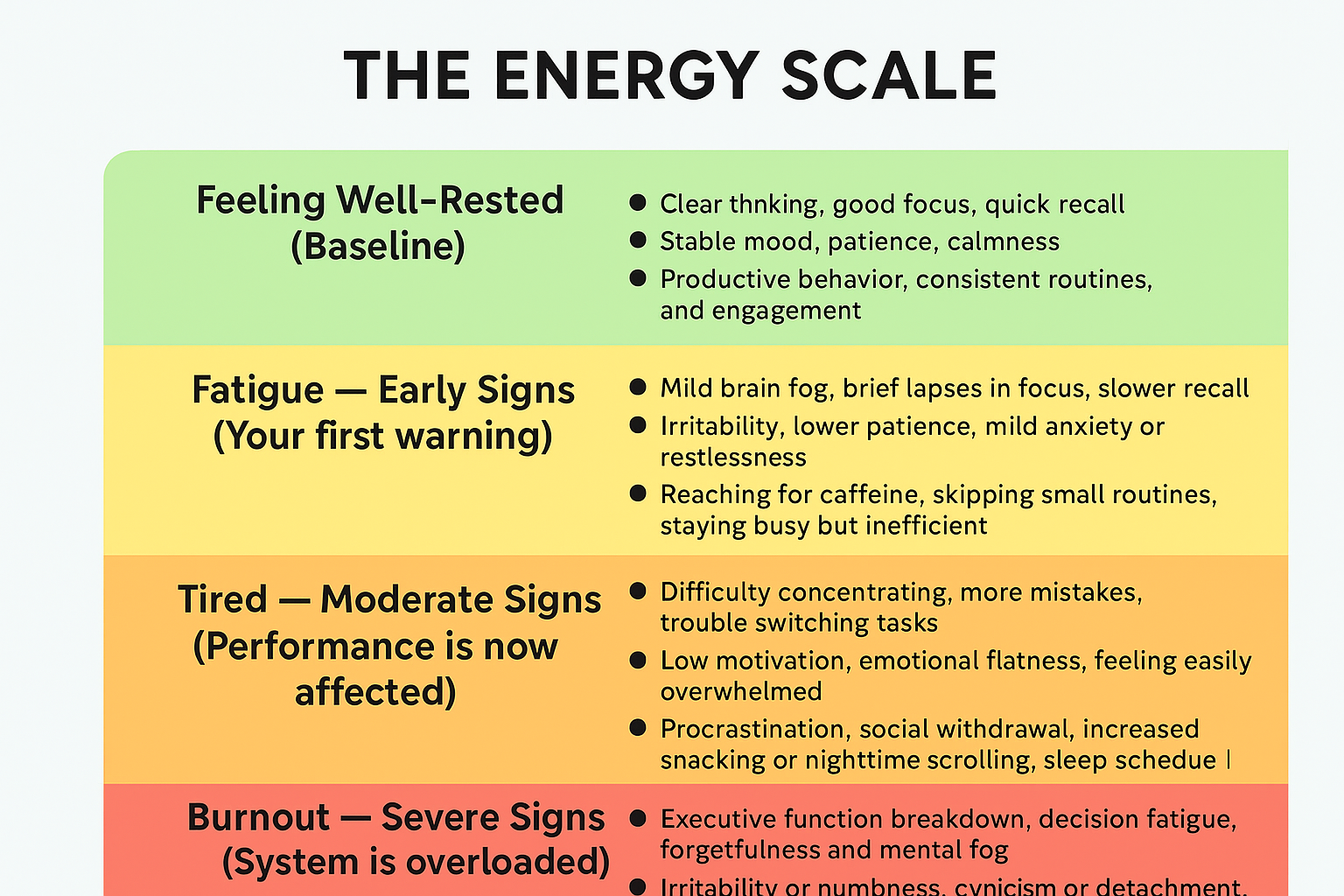
THE ENERGY SCALE
Understanding your energy isn’t just about counting hours of sleep—it’s about recognizing the subtle shifts in your body, mind, and behavior that signal where you are on your personal energy scale. From feeling fully rested, to the early warning signs of fatigue, through moderate tiredness that begins to impact performance, and finally to severe burnout when your system is overloaded, each stage comes with distinct cognitive, emotional, and behavioral cues. By tuning into these markers, you can proactively adjust your rest, routines, and recovery strategies before your energy crashes, helping you stay productive, balanced, and resilient.
Feeling Well-Rested (Baseline)
Clear thinking, good focus, and quick recall
Stable mood, patience, and calmness
Productive behavior, consistent routines, and engagement
Fatigue — Early Signs (Your first warning)
Mild brain fog, brief lapses in focus, slower recall
Irritability, lower patience, mild anxiety or restlessness
Reaching for caffeine, skipping small routines, staying busy but inefficient
Tired — Moderate Signs (Performance is now affected)
Difficulty concentrating, more mistakes, trouble switching tasks
Low motivation, emotional flatness, feeling easily overwhelmed
Procrastination, social withdrawal, increased snacking or nighttime scrolling, sleep schedule drifting
Burnout — Severe Signs (System is overloaded)
Executive function breakdown, decision fatigue, forgetfulness and mental fog
Irritability or numbness, cynicism or detachment, loss of drive or pleasure
Avoidance, shutdown, or isolation, reliance on caffeine/alcohol to cope, inconsistent sleep, drop in work quality or missing commitments
SLEEP
Sleep and rest are not a luxury for high-performers—it’s a cornerstone of sustained focus, productivity, and emotional regulation. Optimizing sleep goes beyond hours in bed; it’s about creating consistent routines, a supportive environment, and understanding the subtle factors that influence restorative rest.
Key Principles
Consistency over perfection matters most: a stable sleep/wake schedule strengthens circadian rhythm and improves recovery. Prioritize quality over quantity, because deep sleep and REM stages drive emotional regulation, memory consolidation, and physical repair. Nighttime sleep is irreplaceable; naps and NSDR sessions support recovery but cannot fully replicate the hormonal and neurological benefits of nighttime rest. Reduce evening stimulation by limiting screens, heavy meals, bright lights, and intense workouts before bed. Finally, supporting airway health is crucial—mild sleep apnea is common, often overlooked, and can significantly degrade sleep quality even in high-functioning adults.
Why Cooling Matters
Falling asleep requires a drop in core body temperature of 2–3°F (≈1°C). Warm environments can hinder this natural decline, leading to trouble falling asleep, fragmented rest, lower deep sleep, elevated nighttime heart rate, reduced HRV, and morning grogginess. Aim for a bedroom temperature of 60–67°F (15.5–19.5°C). Cooling strategies include keeping the room cool, using a fan or cracked window, taking a warm shower 60–90 minutes before bed to trigger the post-shower temperature drop, selecting breathable bedding, avoiding heavy pajamas, and moving intense workouts earlier in the day.
The Often-Missed Sleep Disruptor: Mild Sleep Apnea
Mild obstructive sleep apnea (OSA) affects roughly 1 in 6 adults, often without obvious symptoms. Even brief airway interruptions fragment sleep, reduce recovery hormones, increase next-day anxiety or irritability, impair focus and memory, elevate resting heart rate, lower HRV, and cause fatigue despite sufficient sleep hours. Common signs include unrefreshing sleep, snoring, morning headaches, frequent awakenings, gasping or choking at night, teeth grinding, daytime sleepiness, and elevated nighttime heart rate. High-risk individuals include those with stress, recent weight gain, larger neck circumference, back-sleepers, and those with chronic insomnia. Strategies to improve airway health include side-sleeping, limiting alcohol before bed, using nasal strips, reviewing sleep data, and consulting a physician for a home sleep test if symptoms persist.
Establishing a Simple Sleep Schedule
Anchor your day with a consistent wake time. Cool your environment to signal readiness for sleep, and follow a 30–60 minute wind-down routine that may include dimming lights, light stretching, reading, or NSDR. Set a bedtime 7–9 hours before waking and reduce evening stimulation. Morning sunlight within 30 minutes of waking reinforces your circadian rhythm.
Non-Sleep Deep Rest (NSDR)
NSDR is a powerful recovery tool that engages the parasympathetic nervous system, reduces sympathetic activation, and improves HRV. Studies show it enhances connectivity in brain networks related to attention, emotional regulation, and memory. Optimal sessions last 10–40 minutes; longer sessions may induce grogginess. Key elements include a quiet space, lying on your back with eyes closed, focusing on slow exhalations, and aiming to reduce cognitive load. Benefits include increased baseline dopamine, stress reduction, improved physical recovery, enhanced memory, and emotional regulation. NSDR complements, but does not replace, nighttime sleep.
Practical Steps & Homework
Complete one NSDR/Yoga Nidra session today (10–40 min)
Try NSDR during lunch or short work breaks
Set a consistent wake-up time every day for a week
Use a cooling strategy before bed tonight
Track changes in focus, energy, and sleep quality over 3–5 days
NSDR Resources
YouTube:
10–15 min: https://www.youtube.com/watch?v=6p_yaNFSYao
20–30 min: https://www.youtube.com/watch?v=1vx8iUvfyCY
Spotify: Search “Yoga Nidra” or “NSDR”