Why High Achievers Can Struggle With Intimacy
High achievement can look like confidence from the outside.
You are disciplined. You are capable. You solve problems. You take responsibility. You know how to get things done.
But those same strengths can become a problem in relationships when doing replaces being.
You can build a successful career while remaining uncomfortable with vulnerability. You can manage a team while struggling to communicate your own needs. You can solve everyone else's problems while having little idea what you actually feel.
This is one way I think about high achievement through Robert Moore and Douglas Gillette's King, Warrior, Magician, Lover framework. Their model describes four archetypal capacities of mature masculinity: the King brings order and generativity, the Warrior provides disciplined action, the Magician brings awareness and understanding, and the Lover brings connection, aliveness, sensuality, and meaning. (Google Books)
For many high achievers, the first three can become highly developed.
The Lover can get left behind.
When Being Good at Life Isn't the Same as Being Connected to Life
The Warrior knows how to push.
The Magician knows how to analyze.
The King knows how to organize and take responsibility.
These are valuable capacities. They help you build a career, solve problems, protect what matters, and accomplish difficult things.
But relationships don't operate primarily through achievement.
Your partner doesn't necessarily need another problem solved.
They may want to know what you're feeling.
They may want you to slow down.
They may want you to notice them.
They may want to experience you rather than simply experience everything you do for them.
This can be uncomfortable for a person who has learned that their value comes largely from competence.
When something goes wrong, the instinct is:
Fix it.
When someone is upset:
Solve it.
When you're struggling:
Work harder.
When you're uncertain:
Figure it out.
But intimacy sometimes asks for something completely different:
Stay. Feel. Listen. Be known.
The Lover Is Not Just About Romance
This is where Moore's concept of the Lover is particularly useful.
The Lover isn't simply the part of a man that wants sex or romance. Moore and Gillette describe the Lover as a capacity for vividness, passion, sensuality, empathy, connection, and feeling alive. They argue that the Lover keeps the other masculine energies connected to humanity and gives them their deeper purpose. (Fluid Self)
Without the Lover, achievement can become strangely empty.
You can accomplish something and immediately move to the next goal.
You can receive praise and feel uncomfortable accepting it.
You can have a successful career and still feel lonely.
You can have a partner and still feel emotionally alone.
You can spend your entire life building something without ever stopping long enough to experience the life you're building.
That isn't necessarily depression or a relationship disorder.
Sometimes it is simply a life that has become very good at doing and not very good at being.
Why Vulnerability Can Feel Like Weakness
High achievers often become extremely good at controlling what other people see.
You show competence.
You show confidence.
You show productivity.
You show that you can handle things.
But intimacy requires another kind of strength: allowing someone to see what isn't under control.
“I'm scared.”
“I don't know what to do.”
“I need you.”
“That hurt me.”
“I'm proud of you.”
“I really love you.”
For someone accustomed to operating through competence, these statements can feel surprisingly exposed.
The problem isn't necessarily that you don't have emotions.
You may simply have become much better at managing them than experiencing and communicating them.
The Magician Can Become a Hiding Place
This is particularly relevant to high-achieving, analytical men.
Moore describes the healthy Magician as the capacity for awareness, reflection, and insight. But he also describes a shadow form in which a person becomes so detached and analytical that he observes life instead of participating in it. (Fluid Self)
You can understand your relationship exceptionally well without actually changing it.
You can read every book about attachment.
You can analyze your childhood.
You can understand your partner's psychology.
You can explain exactly why the conflict happened.
And still never say:
“I'm hurt.”
Or:
“I miss you.”
Or:
“I was wrong.”
Understanding yourself is valuable.
But insight isn't intimacy.
At some point, you have to stop analyzing the experience and actually enter it.
The Warrior Can Become Distance
The Warrior is useful because relationships require boundaries, courage, and action.
But an overdeveloped Warrior can turn every relationship problem into something to conquer.
You become focused on being right.
You defend your position.
You become rigid.
You withdraw when conflict becomes emotionally intense.
Or you approach relationships like another area where you need to perform.
This can create a strange paradox:
You are fighting for your relationship while your partner is asking you to simply be with them.
Healthy strength isn't the absence of vulnerability.
It is having enough strength that vulnerability doesn't threaten your identity.
The King Has a Different Kind of Leadership
The mature King isn't simply the man who takes charge.
Moore and Gillette describe the King as bringing order, stability, generosity, and affirmation. His role is not merely to control but to create an environment where other people can flourish. (Fluid Self)
In a relationship, that can look very different from being the person who always has the answer.
It can mean creating enough safety that your partner can tell you the truth.
It can mean blessing rather than evaluating.
It can mean noticing your partner's strengths and helping them become more fully themselves.
And it requires something many high achievers aren't accustomed to:
Your partner isn't another project to optimize.
They are another person to encounter.
The Goal Isn't to Become Less Ambitious
This isn't an argument against achievement.
You don't need to become less disciplined, less ambitious, or less capable.
The goal is integration.
The Warrior should still be able to act.
The Magician should still be able to understand.
The King should still be able to lead and create stability.
But the Lover needs a seat at the table.
Because without the Lover, those capacities can become disconnected from the very things that make life meaningful.
You may build an impressive life and have no one you feel safe enough to share it with.
You may become highly successful while becoming increasingly emotionally unavailable.
You may win the game and discover that you don't actually know how to enjoy being alive.
What Does Developing the Lover Look Like?
It starts surprisingly simply.
Notice what you feel instead of immediately solving it.
Tell someone you appreciate them without turning it into a joke.
Receive a compliment without explaining why it isn't true.
Touch your partner without expecting sex.
Go on a date without trying to make it productive.
Tell someone you love them and let yourself feel what happens.
Allow yourself to enjoy something without needing to accomplish anything.
Stay present when someone you love is hurting instead of immediately trying to fix it.
These aren't soft skills.
They are practices of being in relationship.
The mature man isn't simply the man who can control himself, accomplish his goals, and handle difficult circumstances.
He is also capable of being moved, connected, playful, affectionate, receptive, and fully alive.
That's the Lover.
And for some high achievers, the next stage of growth isn't learning how to accomplish more.
It's learning how to actually be there for the life they've already accomplished.
Pornography: When Sexual Stimulation Starts Working Against You
Pornography is everywhere. For many people, it is occasional sexual entertainment. For others, it gradually becomes a habit that takes more time, attention, and sexual energy than they intended to give it.
The important question isn't simply “How often do you watch porn?”
It's:
“What role does pornography play in your life?”
If you repeatedly use it despite wanting to stop, find yourself choosing it over dating or intimacy, or rely on it to manage boredom, loneliness, stress, or difficult emotions, it may be worth taking a serious look at the pattern.
Gary Wilson's Your Brain on Porn popularized one explanation for why internet pornography can be particularly compelling: modern pornography combines sexual stimulation, unlimited novelty, immediate access, and virtually endless choice. His argument is that repeatedly pairing sexual arousal with this environment can reinforce learned patterns of arousal and reward.
The current research doesn't support the idea that everyone who watches pornography becomes addicted. But problematic pornography use is a legitimate clinical concern, and the ICD-11 recognizes Compulsive Sexual Behavior Disorder when there is persistent difficulty controlling repetitive sexual behavior accompanied by significant impairment or distress.
The Problem With Unlimited Novelty
Your brain is designed to pay attention to things that are rewarding and potentially important.
Internet pornography gives you an unusual amount of sexual novelty.
One person.
Then another.
Another body.
Another scenario.
Another video.
Something more novel.
Something more stimulating.
And you can keep searching indefinitely.
That is very different from ordinary partnered sexuality.
Real intimacy involves another human being. There is familiarity. There are limitations. You have to communicate. You have to tolerate rejection and vulnerability. Your partner has preferences and boundaries.
Pornography allows you to bypass much of that.
You can experience sexual stimulation without having to experience sexual vulnerability.
For some people, that distinction becomes important.
When Pornography Becomes a Substitute
Imagine you're lonely.
You could text someone.
You could go on a date.
You could call a friend.
You could risk approaching someone you're attracted to.
Or you could open your phone and immediately receive sexual stimulation.
The last option is much easier.
That doesn't mean pornography inevitably makes people avoid relationships. But when pornography consistently becomes the response to loneliness, rejection, boredom, or sexual frustration, it can reinforce avoidance.
The cycle can become:
Discomfort → pornography → relief → less need to confront the discomfort.
And that can matter when the discomfort is something you actually need to work through.
Maybe you're afraid of rejection.
Maybe you don't know how to flirt.
Maybe you're lonely.
Maybe you're struggling with intimacy.
Maybe you're frustrated in your relationship.
Pornography can give you an immediate way to change how you feel without requiring you to address the underlying problem.
Pornography vs. Intimacy
One of the biggest differences between pornography and healthy partnered sexuality is mutuality.
Pornography is something you consume.
Intimacy is something you participate in.
Real sexual intimacy requires you to notice another person.
What do they like?
What don't they like?
Are they comfortable?
What are they feeling?
How do they respond to you?
Can you communicate what you want?
Can you tolerate not getting exactly what you want?
Can you remain connected when sex isn't perfect?
Those are not obstacles to intimacy.
Those are intimacy.
For some people, pornography can become an easier alternative because it eliminates the vulnerability of being known.
What Happens When You Try to Stop?
This is where Your Brain on Porn becomes particularly useful as a framework.
If pornography has become strongly associated with particular situations—being alone at night, getting into bed, feeling stressed, using your phone, or experiencing sexual frustration—the urge can become highly automatic.
You may not consciously decide:
“I'm going to watch pornography.”
Instead, you suddenly find yourself opening a browser.
That's a learned behavior.
And learned behaviors can be changed.
A 2022 systematic review found preliminary evidence that treatments for problematic pornography use and CSBD can improve symptoms, with particularly promising evidence for cognitive-behavioral approaches, although the research base remains limited and more rigorous studies are needed.
How to Quit
If you've decided pornography is no longer serving you, don't make your entire strategy “try harder.”
1. Remove the Easy Access
Make pornography harder to reach.
Delete saved material.
Unfollow triggering accounts.
Use appropriate content restrictions.
Keep your phone away from your bed.
Change the situations where you reliably use.
You're not proving weakness by creating barriers.
You're changing the environment around a learned behavior.
2. Know Your High-Risk Moments
Write down your three most common triggers.
For example:
Late at night + alone + phone
Stress + finished work + home alone
Loneliness + rejection + drinking
Then create a specific alternative for each.
Don't just say “I'll do something else.”
Say:
“If I get the urge after 10 p.m., my phone stays downstairs and I take a shower or read in bed.”
3. Learn to Experience the Urge
You don't have to make the urge disappear.
You have to learn that an urge can exist without becoming an action.
Delay.
Stand up.
Leave the room.
Move your body.
Get around other people.
Let the intensity rise and fall.
Every time you experience an urge without automatically responding, you're practicing a different pattern.
4. Replace What Porn Was Doing
This is essential.
If pornography was providing:
Stimulation → find healthy stimulation.
Connection → build connection.
Relief → develop regulation.
Escape → address what you're escaping.
Sexual expression → develop a healthier relationship with sexuality.
If you simply remove pornography without addressing its function, you're leaving an empty space.
5. Address the Shame
Don't turn quitting into another reason to hate yourself.
A lapse doesn't mean:
“I'm broken.”
It means:
“Something about my current system didn't work.”
Figure out what happened.
What was the trigger?
What were you feeling?
Where was the opportunity to intervene?
What needs to change?
Then adjust the plan.
6. Build the Life You Were Using Porn to Avoid
This is the deeper work.
If pornography has become your answer to loneliness, build relationships.
If it's your answer to boredom, build a more engaging life.
If it's your answer to rejection, learn to tolerate rejection.
If it's your answer to sexual frustration, learn to experience desire without immediately satisfying it.
If it's your answer to emotional pain, learn to face the pain.
The goal isn't simply to become someone who doesn't watch pornography.
The goal is to become someone who doesn't need pornography to regulate his life.
Shame and Addiction: When “I Did Something Wrong” Becomes “Something Is Wrong With Me”
Addiction and shame often become intertwined. Someone struggles with a behavior, experiences consequences, and then begins to judge themselves for continuing to struggle.
Over time, the focus can shift from “I don't like what I'm doing” to “There is something wrong with me.”
This distinction is central to John Bradshaw's work on what he called toxic shame. In Healing the Shame That Binds You, Bradshaw described how shame can become internalized, moving beyond an evaluation of our behavior and becoming a judgment about who we are. He connected toxic shame with compulsive behaviors, addiction, relationships, and difficulties with intimacy.
What Is Shame?
Guilt and shame can look similar, but they affect us differently. Guilt says, “I did something wrong.” Shame says, “Something is wrong with me.”
Guilt can actually be useful. If you hurt someone, guilt can motivate you to take responsibility and repair the relationship. Shame tends to move in a different direction. Instead of focusing on what happened, it attacks your identity.
You don't just think, “I made a mistake.” You think, “I'm a failure.”
You don't think, “I lied.” You think, “I'm a dishonest person.”
You don't think, “I'm struggling with this behavior.” You think, “I'm broken.”
That shift is important because when shame becomes part of your identity, changing a behavior can feel like trying to prove that you are a different person.
How Shame Develops
Bradshaw placed significant emphasis on childhood and family experiences in the development of toxic shame. Children depend on the people around them to understand themselves and their emotions. When they are repeatedly criticized, rejected, humiliated, neglected, or made to feel that their needs and emotions are unacceptable, they may begin to internalize those experiences.
A child usually doesn't have the ability to think, “The adults around me are struggling with their own limitations.” Instead, they may conclude, “There must be something wrong with me.”
That belief can follow someone into adulthood. Eventually, it may become so familiar that it no longer feels like a belief. It simply feels like the truth.
This can lead people to organize their lives around avoiding that feeling. They may become perfectionistic, overachieving, highly independent, overly accommodating, defensive, or withdrawn. They may constantly seek approval or try to prove their worth through achievement.
Shame and Addiction
This is one place where shame and addiction can intersect.
When someone feels deeply inadequate, rejected, lonely, overwhelmed, or disconnected from themselves, they naturally want relief. An addictive behavior can provide that relief temporarily.
Alcohol may numb emotional pain. Pornography may provide validation or a sense of intimacy. Gaming may provide escape and competence. Work may provide achievement and a sense of worth. Other behaviors may provide stimulation, comfort, or distraction.
The behavior may not be addressing the underlying problem. It is changing how the person feels for a while.
Then the relief wears off.
The person sees the consequences of the behavior and feels ashamed again. They may have broken a promise, hurt someone, lost money, missed work, or simply feel disappointed that they returned to the behavior yet again.
The cycle becomes:
Shame → escape → temporary relief → consequences → more shame.
The behavior becomes a way to escape the very feelings that the behavior eventually creates.
When Struggling Becomes Evidence
One of the most painful parts of this cycle is what repeated failure can begin to mean.
Someone might think:
“I've tried to stop so many times.”
“I know better than this.”
“Why can't I control myself?”
Eventually, the struggle itself becomes evidence for the shame story.
“See? I really am weak.”
This is where it becomes important to separate the behavior from identity.
You can have a serious problem without being a fundamentally defective person.
You can hurt someone without being irredeemable.
You can need treatment without being weak.
You can be responsible for your behavior without believing that you are the sum of your worst decisions.
Shame Also Affects Relationships
Shame becomes especially powerful in relationships because relationships require us to be seen.
If you believe the real you is unacceptable, vulnerability can feel dangerous. You may hide things from your partner, become defensive when confronted, avoid difficult conversations, or constantly seek reassurance.
You may also become a people pleaser, trying to make yourself indispensable so that you won't be rejected. Or you may push people away because rejecting them first feels safer than waiting for them to reject you.
The underlying fear is often simple:
“If you really knew me, you might not want me.”
This is why shame work can be important for relationships. The goal isn't simply to communicate better. It can also involve learning that you can be honest, imperfect, and vulnerable without automatically expecting rejection.
Healing Shame Requires a Different Mirror
Shame often develops through relationships, which means changing it isn't always something you can accomplish through insight alone.
You need corrective experiences.
I think of this as finding a “good mirror.”
A good mirror is someone who can see you clearly without shaming you. They don't ignore your problems or tell you that everything you do is okay. Instead, they can see your strengths, struggles, mistakes, and potential without reducing you to any one of them.
They might be able to say:
“You made a mistake, but I don't see you as a bad person.”
“You're struggling right now, but I still see your strengths.”
“I understand why you responded that way, and I also think you need to handle it differently.”
That is different from either criticism or simply reassuring you that everything is fine.
A good mirror gives you the experience of being known without being condemned.
A therapist can be a good place to begin developing this experience. Therapy provides a relationship where you can explore parts of yourself that have historically been difficult to acknowledge without immediately being judged or rejected.
But ideally, these experiences extend beyond therapy.
A close friendship. A healthy partner. A trusted mentor. A supportive community.
These relationships can give you repeated experiences of something shame has taught you isn't possible:
“Someone can really know me and still value me.”
At the same time, another person cannot do all of this work for you. You also have to learn to recognize yourself more accurately. That means noticing the shame story, questioning it, taking responsibility when necessary, and learning to treat yourself with the same honesty and compassion you would offer someone you care about.
Do your own work + experience healthy relationships.
Over time, those experiences can help you develop an internal mirror that is less critical, less distorted, and more compassionate.
Perhaps one of the deepest shifts in healing shame is moving from:
“How do I become someone who is worthy of being loved?”
to:
“What happens when I allow myself to be known as I actually am?”
ADHD and Addiction: Understanding the Pull of Immediate Relief
ADHD does not cause addiction, and having ADHD does not mean you will develop an addiction. But some of the challenges associated with ADHD can make certain behaviors particularly rewarding and, for some people, harder to control.
To understand why, it helps to look beyond the behavior itself.
The better question isn't simply:
“Why can't I stop?”
It's:
“What is this behavior doing for me?”
When Your Brain Wants Something Right Now
One challenge with ADHD is that immediate rewards can be especially compelling.
You may know that exercising, cleaning your house, finishing your work, or going to bed will benefit you later. But gaming, scrolling, pornography, food, shopping, gambling, or substances can offer something immediately:
stimulation, pleasure, relief, or escape.
That doesn't mean someone with ADHD doesn't care about the future.
You may care very deeply about the consequences.
The difficulty is that the reward available right now can be much easier to access than the reward that comes later.
From Boredom to Stimulation
This becomes especially relevant when you're bored or understimulated.
For some people with ADHD, boredom isn't simply a lack of interest. It can feel restless, uncomfortable, or difficult to tolerate.
A highly stimulating behavior provides an immediate answer.
Bored → seek stimulation → feel better.
If you repeat that pattern enough, your brain begins learning:
“When I feel this way, this is what I do.”
The behavior starts becoming less of a deliberate choice and more of an automatic response.
When the Behavior Becomes Emotional Regulation
The same thing can happen with difficult emotions.
You have a stressful day and want to shut your brain off.
You feel lonely and want connection.
You're overwhelmed and want an escape.
You're frustrated and need some relief.
You feel exhausted and don't have the energy to do anything difficult.
The behavior changes your internal experience quickly.
So the pattern becomes:
Uncomfortable feeling → behavior → temporary relief.
This is an important distinction.
The behavior may not actually be solving the underlying problem. It's helping you change how you feel about the problem.
And when something reliably provides relief, it becomes much easier to reach for it the next time that feeling appears.
Why Stopping Can Be Hard
Now add ADHD-related difficulties with impulse control, task switching, and time awareness.
You might tell yourself:
“I'll just play for a little while.”
“I'll scroll for ten minutes.”
“I'll have one.”
But the transition away from something highly rewarding can be difficult.
Then you look at the clock and realize much more time has passed than you intended.
Now you're behind.
You feel frustrated with yourself.
Maybe you have something important you need to do, but you're already overwhelmed.
And that uncomfortable feeling can create another reason to return to the behavior.
The behavior becomes both the problem and the relief from the problem.
When ADHD and Shame Meet
This is where the pattern can become especially difficult.
Repeatedly losing control of a behavior can lead to self criticism:
“Why do I keep doing this?”
“I should be able to control myself.”
“What's wrong with me?”
For someone who has already accumulated years of difficult experiences with ADHD, these failures can add another brick to the Wall of Awful.
Now the behavior isn't just something you're trying to stop.
Trying to stop reminds you of all the times you've tried before.
That can create a cycle:
ADHD-related difficulty → behavior → consequences → shame → desire for relief → behavior
Not everyone with ADHD experiences this cycle, but when it occurs, addressing only the behavior may not be enough.
Don't Just Remove the Behavior—Understand Its Function
If you want to change an addictive pattern, ask what the behavior is providing.
If it provides stimulation:
Where else can you get healthy stimulation?
If it provides relief:
What other ways can you regulate stress?
If it provides connection:
Where can you build genuine connection?
If it provides escape:
What are you trying to escape from?
If it provides a sense of accomplishment:
Where else can you experience competence and progress?
This doesn't mean every need can be replaced with a healthier version overnight.
It means you're beginning to build more options.
Create More Space Between the Urge and the Action
When something is highly rewarding, relying on willpower alone can be difficult.
Instead, create friction and structure.
Put boundaries around when and where you engage in the behavior.
Use timers.
Change your environment.
Remove easy access when possible.
Create accountability.
Build activities into your day that provide stimulation, movement, rest, and connection.
Most importantly, don't wait until you're already in the middle of the behavior to decide what you're going to do.
Make the plan when you're thinking clearly.
The goal isn't to eliminate every temptation.
It's to create enough space between “I want this” and “I'm doing this” that you have an opportunity to choose.
ADHD Isn't a Moral Failure
If you repeatedly struggle to regulate a behavior, it's easy to turn the problem into a judgment about yourself.
But difficulty regulating attention, impulses, stimulation, or emotions isn't evidence that you're lazy or lack character.
At the same time, understanding ADHD doesn't remove responsibility.
You can understand why something is difficult and still take responsibility for changing it.
The goal is not to excuse the behavior.
It's to understand the conditions that make it more likely, change those conditions where you can, and develop better ways of meeting the needs the behavior has been serving.
Because ultimately, the goal isn't simply:
“How do I stop doing this?”
It's:
“How do I build enough regulation, structure, and meaningful alternatives that I don't need this behavior to manage my life?”
ADHD and the Wall of Awful: When Starting Feels Harder Than It Should
Have you ever looked at something that should take 10 minutes and thought:
“Why can’t I just do this?”
You know how to do it. You may even want to do it. But somehow, you can't seem to start.
You put it off. You do something else. You think about it again. You feel guilty. Then the task starts to feel even harder.
For people with ADHD, this experience can have less to do with laziness or not caring and more to do with the emotional weight that has accumulated around the task.
ADHD coach and educator Brendan Mahan developed the concept of the Wall of Awful to describe this experience. He describes it as the emotional barrier that develops from repeated failures and negative experiences, making it harder to initiate tasks or take risks. (Brendan Mahan)
What Is the Wall of Awful?
Imagine that every difficult experience adds another brick to a wall.
You forgot the assignment.
You missed the deadline.
Your parent criticized you.
Your teacher called you careless.
Your boss reminded you again.
Your partner got frustrated.
You promised yourself you'd do better—and didn't.
Each experience can leave behind guilt, disappointment, frustration, anxiety, shame, or fear of failing again. Mahan describes these accumulated emotions as the bricks that build the Wall of Awful. (Brendan Mahan)
Eventually, you aren't just facing the task.
You're facing everything the task has come to represent.
Why a Simple Task Can Feel So Difficult
Consider an email you've been avoiding.
On paper, it might take five minutes.
But emotionally, it might represent:
“I'm already behind.”
“They're probably annoyed with me.”
“I should have answered this days ago.”
“Why do I keep doing this?”
“I'm going to have to explain myself.”
So when you look at the email, your brain isn't necessarily responding to an email.
It's responding to the entire wall surrounding it.
Avoiding it provides temporary relief.
But then the email remains unanswered, another negative experience gets added, and the wall gets a little taller.
Avoidance can protect you from the uncomfortable feeling in the moment while making the next attempt harder.
The Wall Isn't a Character Flaw
This is an important distinction.
If you repeatedly struggle with something, it's easy to develop an explanation based on character:
“I'm lazy.”
“I'm irresponsible.”
“I don't care enough.”
“I'm just bad at adulting.”
But executive functioning difficulties can make planning, organizing, initiating, shifting attention, and following through genuinely difficult.
And repeated difficulty can create an emotional response to those difficulties.
So sometimes the problem isn't simply:
“I don't know how to do this.”
It's:
“I know how to do this, but I have so much emotional baggage attached to doing it that starting feels overwhelming.”
The Wall Can Show Up Everywhere
The Wall of Awful isn't limited to work or school.
You might experience it with:
Answering emails
Paying bills
Cleaning your home
Making appointments
Exercising
Starting a project
Having a difficult conversation
Returning someone's call
Asking for help
Managing paperwork
Following through on something you've already promised
Sometimes it can even show up in relationships.
If you've repeatedly been criticized for forgetting something, you may avoid the conversation because you already expect disappointment.
If you've repeatedly struggled with organization, you may avoid looking at your finances because you anticipate feeling ashamed.
The task itself may be manageable.
The emotional history attached to the task is what makes it feel enormous.
How Do You Get Through the Wall?
The first step is recognizing that you're dealing with a wall at all.
Instead of:
“Why am I being so lazy?”
Try:
“What am I feeling about this task?”
Maybe you're embarrassed.
Maybe you're afraid you'll fail again.
Maybe you're overwhelmed.
Maybe you're anticipating criticism.
Maybe you're already disappointed in yourself.
Naming what is happening can help you stop treating the emotional reaction as evidence that something is wrong with you.
Then make the task smaller.
Don't focus on “clean the house.”
Focus on “clear the kitchen counter for five minutes.”
Don't focus on “fix my finances.”
Focus on “open the bank account.”
Don't focus on “answer all my emails.”
Focus on “answer one.”
You're not trying to climb the entire wall at once.
You're looking for a place to start.
Rebuilding Trust in Yourself
One of the most important parts of this work is creating new experiences.
If you've spent years telling yourself:
“I never follow through.”
then every small experience of following through matters.
Not because you need to prove your worth.
But because you're building a different history.
You planned something—and did it.
You started before you felt ready.
You asked for help.
You finished one small task.
You recovered after getting off track instead of giving up completely.
Over time, those experiences can become new bricks—but this time, they're building something different:
evidence that you are capable of responding differently.
You Are Not Your Wall
The Wall of Awful can make a task feel like a judgment about who you are.
It isn't.
Having ADHD doesn't mean you're lazy, careless, unmotivated, or incapable.
It means you may need to approach certain challenges differently—and sometimes the emotional history surrounding those challenges needs attention too.
The goal isn't to shame yourself into becoming more organized.
It's to understand what is getting in the way, develop the skills and structure you need, and make it easier to try again.
Sometimes the first step isn't climbing the wall.
It's realizing that there is a wall there in the first place.
Harm Reduction: A Practical Approach to Changing Addictive Patterns
When you're caught in an addictive pattern, the instinct is often to think, “I just need to stop.”
But addictive behaviors usually serve a purpose. They may provide relief from stress, loneliness, shame, boredom, pain, or a sense of disconnection. Understanding that function doesn't excuse the behavior. It gives you a place to begin changing it.
My approach to harm reduction starts with a simple progression:
Contain the behavior → Understand the pattern → Face the pain → Build connection → Create a fuller life.
1. Contain the Behavior
Before you can change an addictive pattern, you often need to create some space between the urge and the behavior.
This is where I draw from Robert Moore's concept of containment. In his archetypal framework, the mature Lover represents our capacity for connection, pleasure, vitality, and engagement with life. The shadow side, sometimes described as the Addicted Lover, can involve seeking intensity or gratification without sufficient boundaries.
Containment means creating boundaries around the behavior so that it doesn't run your life.
This might look like:
Removing easy access to the behavior.
Creating specific times or situations when the behavior is allowed or not allowed.
Putting limits in place before an urge occurs.
Changing routines that consistently lead to the behavior.
Tracking when and why urges occur.
Telling someone you trust about what you're trying to change.
Creating a plan for what you will do when an urge shows up.
The goal isn't to prove you have enough willpower. It's to create enough structure that you don't have to rely on willpower every time.
2. Understand What the Behavior Is Doing for You
Once you've created some containment, start getting curious about the pattern.
Ask yourself:
When do I usually do this?
What am I feeling immediately beforehand?
What does the behavior give me?
What does it help me avoid?
Maybe it gives you relief.
Maybe it gives you stimulation.
Maybe it helps you feel connected.
Maybe it allows you to escape from shame, loneliness, anger, boredom, or exhaustion.
The question isn't “What's wrong with me?”
It's “What need is this behavior trying to meet?”
That question can shift the work from shame toward understanding.
3. Reorient Toward the Pain
Eventually, understanding the pattern isn't enough.
If the behavior has been helping you escape something painful, you will eventually have to develop a different relationship with that pain.
This is where I take an existential approach.
Some pain cannot be eliminated. Loss happens. Relationships change. Life can be unfair. You may carry regret, loneliness, uncertainty, or wounds that don't have a quick solution.
The goal isn't to make yourself enjoy suffering.
It's to develop the capacity to say:
“This hurts, and I don't have to immediately escape it.”
That might mean learning to sit with loneliness without immediately reaching for stimulation. Feeling shame without turning it into self destruction. Experiencing anxiety without immediately trying to shut it down.
No one else can do that inner work for you.
But you don't have to do it alone.
4. Move Toward Connection
One of the problems with many addictive patterns is that they can gradually replace real connection.
You may begin turning toward the behavior instead of your partner, friends, family, community, or faith.
So part of recovery is learning to move toward people instead of away from them.
That might mean:
Telling someone when you're struggling.
Spending time with people who help you feel grounded.
Joining a group or community.
Allowing yourself to be known instead of hiding.
Repairing relationships that have been damaged.
Asking for help before you're in crisis.
There is a difference between facing your pain yourself and facing it by yourself.
You have to experience your own emotions, make your own choices, and take responsibility for your recovery. But connection can give you support, perspective, accountability, and a place to belong while you do that work.
5. Build Something Better
Taking away an addictive behavior can leave a hole.
If you don't fill that space with something meaningful, the old behavior can become increasingly attractive.
This is where the healthier side of the Lover becomes important: connection, pleasure, creativity, play, intimacy, purpose, and vitality.
Ask yourself:
What makes me feel genuinely alive?
Where do I experience healthy pleasure?
Who do I want to be connected to?
What am I curious about?
What gives my life meaning?
What kind of person am I trying to become?
Recovery isn't only about learning to say no to something.
It's about developing more reasons to say yes to your life.
When You Need More Support
Harm reduction strategies can be helpful, but they are not a substitute for intensive addiction treatment when an addiction is severe.
If you've tried many strategies and continue to experience significant loss of control, dangerous substance use, serious withdrawal, escalating consequences, or an inability to stay safe, you may need a higher level of care.
That could include working with an addiction counselor, medical provider, intensive outpatient program, residential treatment, or inpatient treatment depending on your circumstances.
There is no shame in needing more help.
If you've already tried many of these strategies and they haven't been enough, that doesn't mean you've failed. It may mean that the problem requires a stronger level of support and containment.
Seeking more intensive treatment can be an act of courage, not weakness.
Washington Addiction Resources
If you are in Washington State and need help finding addiction treatment or recovery services, the Washington Recovery Help Line provides 24/7 confidential support and referrals to treatment and recovery resources throughout the state. Services can include connections to outpatient, residential, withdrawal management, and other substance use treatment options.
Washington Recovery Help Line: 1-866-789-1511
You can also explore substance use treatment resources through the Washington State Health Care Authority.
If you are experiencing a life threatening emergency, call 911. For a mental health or substance use crisis, you can also call or text 988.
The Bigger Picture
Ultimately, the goal isn't simply to control a behavior.
It's to understand why you need it, what you're trying to escape, what you need to face, and what kind of life you want to build instead.
Start with containment.
Get curious about the pattern.
Turn toward the pain.
Move toward connection.
And build a life with enough meaning, vitality, and relationship that the addictive behavior no longer has to carry so much of the weight.
You don't have to do this perfectly. You do have to start paying attention.
The Four C’s of Complimenting Your Partner
One of the most meaningful things you can give your partner is the feeling of being noticed.
Over time, couples can become so familiar with each other that they stop paying attention to the small things that initially drew them together. We may still appreciate our partner, but we don't always express what we're noticing.
A meaningful compliment isn't about finding the perfect thing to say. It's about paying attention to your partner and putting something genuine into words.
A simple way to think about this is the Four C's.
Character — “Who you are”
Notice something distinctive about your partner's personality, character, or the way they move through the world.
Instead of:
“You're a nice person.”
Try noticing something specific:
“I love how you always remember the little things people tell you.”
“You have this ability to make people feel comfortable almost immediately.”
“I really admire how you can be direct with someone without trying to tear them down.”
The more specific the observation, the more your partner can feel that you actually see them.
Contribution — “What you do”
Notice the things your partner contributes that might otherwise go unnoticed.
This isn't just about saying thank you for chores. Look for the particular ways they make your shared life better.
Instead of:
“Thanks for everything you do.”
Try:
“I noticed you took care of that before I even had to ask. I really appreciate that.”
“You always seem to know when the kids need a little extra attention.”
“I know you've been exhausted, but you still made time to check in with me. That meant a lot.”
The compliment becomes more meaningful when it shows you noticed the effort behind the action.
Chemistry — “What I feel”
Notice what your partner brings out in you.
Think beyond “I love you” and pay attention to the specific experience of being with them.
Instead of:
“I love spending time with you.”
Try:
“I love how easily we can turn running errands into something fun.”
“I always feel like I can let my guard down when I'm with you.”
“You make me want to be more playful.”
These compliments tell your partner something they can't know unless you share it: what it feels like to be loved by them.
Cute — “What I'm attracted to”
Notice something specific about your partner's appearance or the way they carry themselves.
Instead of the automatic:
“You look good.”
Try paying attention:
“I love the way you smile when you're trying not to laugh.”
“That color looks really good on you.”
“I don't know what you did differently with your hair today, but I really like it.”
“You looked really good walking into the room just now.”
The point isn't to constantly reassure your partner that they're attractive. It's to let them know you're still paying attention.
Make It Personal
The Four C's aren't four types of compliments you need to check off a list.
They're four ways of paying attention to the person you're with.
Character: What do I notice about who they are?
Contribution: What do I notice them doing?
Chemistry: What do I notice about how I feel with them?
Cute: What do I notice that I'm attracted to?
The best compliment is often something your partner didn't expect you to notice.
That's what makes it feel authentic.
You don't need to become more romantic overnight. Start by paying attention. Notice something specific. And then, instead of keeping the thought in your head, tell them.
When “Rude” Is Actually the Nervous System
We often describe certain social behaviors as rude, awkward, dismissive, or emotionally flat. Someone interrupts, avoids eye contact, speaks bluntly, or misses social cues and we assume it reflects attitude, character, or values.
From a nervous system perspective, this interpretation is often wrong.
Much of what we label as rudeness is actually state-dependent physiology. The nervous system is not prioritizing social grace. It is prioritizing protection.
The Nervous System Comes Before Personality
Human behavior is always filtered through physiological state. When the nervous system perceives safety, the social engagement system comes online. Tone softens. Facial expression becomes responsive. Timing improves. Curiosity and empathy increase.
When the nervous system perceives threat, even subtle threat, the body shifts into survival mode. Social nuance becomes secondary. The result can look like disinterest, bluntness, defensiveness, or awkwardness, even when connection is genuinely desired.
This is not a moral failure. It is biology.
Clinical Language for “Biological Rudeness”
Neuroception mismatch
The nervous system misreads cues of safety or threat. Social signals are processed inaccurately, leading to responses that feel abrupt or poorly timed.
Autonomic dysregulation
The body struggles to shift smoothly between activation and calm. This can show up as tension, clipped speech, irritability, or emotional rigidity in conversation.
Sympathetic overactivation
Fight-or-flight dominance narrows focus and speeds reactions. People may interrupt, speak sharply, appear impatient, or sound aggressive without intending to.
Dorsal vagal dominance
Shutdown states reduce energy and expression. This often appears as withdrawal, flat affect, delayed responses, or social disengagement that can be mistaken for apathy.
Incomplete social engagement activation
The systems responsible for facial expression, vocal tone, and eye contact do not fully activate. Interactions feel awkward or misattuned despite good intentions.
What This Looks Like in Real Life
A person who interrupts may be operating from threat-biased communication, not entitlement.
Someone who seems emotionally distant may be in a shutdown state, not indifferent.
Blunt honesty may reflect sympathetic urgency, not lack of care.
Social avoidance may be a regulation issue, not rejection.
In each case, the nervous system is limiting access to relational skills the person actually values.
Why This Distinction Matters
When we mislabel nervous system states as character flaws, shame increases. Shame further dysregulates the nervous system, reinforcing the very behaviors we are trying to change.
Understanding behavior as state-dependent allows for compassion without excusing harm. It shifts the question from “What’s wrong with you?” to “What state are you in right now?”
That question opens the door to regulation, repair, and growth.
A More Accurate Reframe
What looks like rudeness is often a nervous system prioritizing protection over connection.
When safety increases, social capacity increases. When regulation improves, warmth, flexibility, and attunement follow naturally.
A Simple Way to Work With It
You do not need a complex technique.
First, notice and name the disconnect. Name the behavior, not the person. For example, “Something feels rushed here,” or “I’m noticing we’re talking past each other.”
Second, slow things down. Lower your voice slightly. Pause before responding. Take a breath. Create just enough space for the nervous system to re-orient toward safety.
Connection returns when the body has time to catch up.
Social repair does not come from forcing better behavior.
It comes from restoring enough regulation to reconnect.
Depression 101: Understanding and Working With It
Depression Isn’t Weakness.
Depression isn’t a moral failing, laziness, or a flaw in character.
It’s a mood, a bigger pattern of nervous system shutdown signaling that something in life feels stuck, unsafe, or disconnected.
That heavy chest, low energy, and sluggish motivation aren’t random….
They’re your body saying, “Pay attention. Something needs to change.”
From a Polyvagal perspective, depressive moods arise when the nervous system settles into a sustained shutdown state. The social engagement system withdraws, motivation dips, and energy is conserved.
This is protective: when life feels unpredictable or overwhelming, your system retreats to keep you safe…but the cost is feeling numb, disconnected, or stuck.
When The Nervous System Shuts Down
Depression often isn’t triggered by a single catastrophic event. More commonly, it emerges quietly through the accumulation of everyday stress that never fully resolves. To understand this, it helps to look at how an ordinary day can gradually overwhelm the nervous system and lead to shutdown.
You wake up already tired, not fully rested. Your phone has notifications waiting before you’re out of bed. You skip breakfast because you’re running late. Traffic is heavier than usual. At work, a vague email arrives with no clear expectations. Your body stays slightly braced all morning with shallow breathing, a tight chest, and tension in your jaw. Nothing dramatic happens, but your nervous system remains in low-grade threat without relief.
By early afternoon, the system reaches its limit. A small stressor lands, a minor criticism, a delayed response, a change of plans, and instead of mobilizing, everything drops. Motivation fades. Thinking slows. Emotional flatness sets in. The pull is toward withdrawal, scrolling, sleep, or isolation.
What looks like depression or apathy from the outside is often a nervous system conserving energy after prolonged strain.
Prelude to Depressive Episodes
Childhood experiences and early parenting can shape these reactive patterns. Repeated exposure to misattuned care, neglect, or relational inconsistency can sensitize the nervous system toward withdrawal or freeze under stress.
Significant life events such as loss, illness, or trauma can reinforce the same response.
Over time, these automatic shutdown responses can become familiar, organizing mood, energy, and motivation in ways that resemble depression. Most people respond by withdrawing or distracting themselves, which often deepens the mood. A more effective approach is to notice what is happening, understand the pattern without self-judgment, and experiment with the kinds of stimulation that support the nervous system rather than overwhelm it.
How to work with depressive moods:
1. Name it. Label what you’re feeling. Don’t just say, “I’m depressed.” Identify specific thoughts, losses, or frustrations. Naming the mood gives your mind and body clarity and starts to move you out of automatic shutdown.
2. Break it down. Depression feels like a mountain. Identify small, actionable steps—movement, connection, or meaningful activity—that signal safety and progress to your nervous system. Small wins matter.
3. Move and connect. Your nervous system is like Goldilocks’ porridge: too little stimulation, too much, or just right. Experiment to find what calms or energizes you. Walk, stretch, dance, reach out to safe people, or engage in creative work. The goal isn’t perfection—it’s “just right” for your current state. These are neural recalibration tools.
4. Use it as feedback. Depressive moods point to areas of life that are misaligned with your values, goals, or needs. Notice what’s missing, explore meaning, and take small steps toward purpose and connection.
The Bottom Line…
Depressive moods are not weakness—they’re a signal from your nervous system and life history. Pay attention, experiment with movement and social connection until you find the “just right” stimulation, break down what matters, and take deliberate steps. Your mood is a compass—use it to recalibrate, reconnect, and reclaim your energy and purpose.
Anxiety 101: How to Use It to Your Advantage
Anxiety Isn’t the Enemy.
Let’s get one thing straight: anxiety isn’t a flaw, a chemical imbalance, or a sign that you’re weak. It’s your body and mind sending a very clear message: something in your life feels uncertain, risky, or unresolved. That racing heart, tight chest, or restless energy? That’s your nervous system kicking in, saying, “Pay attention. Something matters here.”
From a Polyvagal perspective, anxiety happens when your nervous system senses threat and shifts out of its safe, social state. Your body goes into high alert (fight/flight) or shuts down (freeze), even if there’s no immediate danger. These reactions are automatic and protective—they’re designed to keep you alive and alert—but they can feel overwhelming if you don’t understand what’s happening.
Most people react the wrong way: they ignore it, push it down, or scroll endlessly through distractions. That’s like ignoring a flashing check engine light on your car. It won’t go away, and it might get worse. The smarter move is to face it head-on.
Here’s how to work with it:
1. Name it. Get specific. Don’t just say “I’m anxious.” What exactly is making you feel off? Writing it down or speaking it aloud gives your nervous system a chance to shift from chaos toward clarity.
2. Break it down. Anxiety explodes when we look at the whole mountain instead of the steps. Take the big, scary unknown and divide it into pieces you can actually influence. One step at a time beats paralysis every single time.
3. Act on it. Movement is medicine. When your body senses you’re taking action, even small steps, your nervous system recalibrates toward safety. Avoidance only feeds anxiety. Action—deliberate, intentional action—is the antidote.
4. Use it. Shift your perspective: anxiety isn’t something to hate; it’s a signal from your nervous system guiding you. When you pay attention, adjust, and move, it becomes a tool for clarity, preparation, and growth.
Caveat: Anxious Attachment and the Deeper Patterns
For many, anxiety isn’t just about situational stress—it’s tied to relational patterns, especially anxious attachment. People with this attachment style experience heightened vigilance and fear of rejection in close relationships, which can amplify everyday anxiety signals. This is where an Adlerian lens becomes essential: anxiety isn’t a personal flaw—it’s a signal pointing to beliefs, patterns, and goals that need adjustment. By exploring early experiences, relational scripts, and life goals, you can shift these patterns, develop a stronger sense of agency, and reduce the intensity of automatic anxious reactions.
Bottom line: anxiety is not your enemy—it’s a compass. It’s your nervous system saying, “Something matters. Pay attention, adjust, act.” By understanding your nervous system, your attachment patterns, and your life goals, you can use anxiety as a tool to live more deliberately, fully, and powerfully.
A Practical Holiday Guide for Hard Family Conversations
Holidays tend to magnify old family patterns. People who want connection end up feeling tense, reactive, or shut down—not because they don’t care, but because they care a lot and don’t know how to protect the relationship and themselves at the same time. This guide is designed to help you do both.
The Core Dynamic (Why This Is So Hard)
Most family conflict during the holidays falls into one of two roles:
1. The Controller
Often anxious, vigilant, and emotionally invested. Tries to manage outcomes through advice, pressure, guilt, reminders, or emotional intensity. Usually wants closeness and stability but expresses it in ways that feel invasive or critical to others.
2. The Avoider
Often internally frustrated or resentful. Has tried to speak up before and felt dismissed, overwhelmed, or punished. Protects themselves by disengaging, going quiet, changing the subject, or limiting contact. Also wants connection—but without conflict.
Neither role is “the bad one.” Both are protective strategies shaped by history. The problem is the loop they create together.
The Goal (What We’re Actually Aiming For)
Not control. Not withdrawal.
The real goal is peace and connection.
That means:
Naming limits clearly
Following through calmly
Expressing positive intent for the relationship
Stepping out of passive-aggressive or reactive cycles
Boundaries are not punishments. They’re information about what makes connection sustainable.
The Boundary Formula (Simple and Effective)
A healthy holiday boundary has three parts:
The Limit – What you will or won’t engage in
The Consequence – What you will do if the pattern continues
The Intent – Why this matters to you and the relationship
Example Structure:
“When ___ happens, I’m going to ___. I’m saying this because I want ___ between us.”
This keeps the focus on your behavior, not changing theirs.
Examples You Can Adapt
If You Tend to Avoid
“I want to spend time together, but when the conversation turns critical or pressuring, I shut down. If that happens, I’m going to step away or change the subject. I’m saying this because I want our time to feel calmer and more connected.”
If You Tend to Control
“I know I can get intense when I’m worried or want things to go well. I’m working on backing off. If I notice myself pushing, I’m going to pause instead of continuing. I really want us to enjoy each other without tension.”
Around Repeated Topics (politics, health, parenting, life choices)
“I’m not willing to discuss that topic during the holidays. If it comes up, I’ll redirect or take a break. I want our time together to feel warm, not stressful.”
What Makes Boundaries Work (and Fail)
They fail when:
They’re delivered with blame, sarcasm, or emotional charge
They rely on the other person changing
They’re explained repeatedly instead of enforced
They work when:
They’re stated once, calmly
The consequence is followed through without drama
The tone signals steadiness, not threat
Consistency matters more than intensity.
Expect Pushback (This Is Normal)
When you change your role in the family system, the system reacts.
You may hear:
“You’re being too sensitive.”
“I’m just trying to help.”
“This is how we’ve always talked.”
Pushback doesn’t mean you’re wrong. It means the pattern is being disrupted.
Stay grounded. Repeat the boundary. Follow through.
Regulating Yourself in the Moment
Before responding, check:
Am I trying to win or protect connection?
Is my body activated right now?
Helpful tools:
Slow your breathing before speaking
Lower your voice
Shorten your sentences
Take a physical break if needed
A regulated nervous system is the most persuasive boundary you have.
After the Holiday: Repair and Integration
If things went poorly, repair matters.
Repair can sound like:
“I didn’t handle that the way I wanted to. I care about us and want to keep working toward better conversations.”
Growth isn’t measured by perfect holidays—it’s measured by less reactivity and faster repair.
Final Reminder
You’re not trying to change your family.
You’re changing how you show up so connection doesn’t require self-abandonment.
That alone shifts the system.
Understanding Yourself Through the Big Five Personality Traits
When it comes to understanding human behavior, the Big Five personality traits are one of the most widely accepted models in modern psychology for describing the major dimensions of personality. Unlike rigid “types,” the Big Five describes broad tendencies that exist on a continuum, meaning everyone has some of each trait in varying degrees. These traits help explain patterns in how you think, feel, and behave—and they’re useful for understanding yourself in relationships, career choices, and everyday life.
To explore your own Big Five personality profile, you can take a free assessment at: https://bigfive-test.com/.
Once you have your results, you can reflect on them independently, process them with a coach, or even share them with a partner to deepen mutual understanding. A simple way to remember them is the acronym OCEAN:
O – Openness to Experience
C – Conscientiousness
E – Extraversion
A – Agreeableness
N – Neuroticism
Unlike labels or pop-psychology types, the Big Five describe broad dimensions of personality that everyone has to varying degrees. Knowing where you fall on each trait can help you understand your behaviors, identify interests, and navigate relationships—all without pathologizing or judging yourself.
1. Openness
Openness reflects how much you seek out new experiences, ideas, and ways of thinking. People who score higher in openness tend to enjoy creativity, abstract thought, and novelty. Those who score lower often find comfort in routine, tradition, and concrete facts. This trait influences how you approach the world—whether you’re energized by discovery or grounded in the familiar. Simply Psychology
Subtraits:
Imagination – How vivid and creative your inner world tends to be.
Aesthetic – Your appreciation for beauty, art, and sensory experiences.
Emotionality – Awareness of your own emotions and emotional depth.
Adventure – Desire for variety, change, and exploration.
Intellect – Interest in ideas, learning, and intellectual challenge.
Liberalism – Openness to new values, unconventional perspectives, and change.
Understanding openness can help clarify whether you’re drawn to explorative work and experiences or whether you thrive in environments with clear structure and predictable rhythms.
2. Conscientiousness
Conscientiousness measures how organized, dependable, and disciplined you tend to be. Individuals high in conscientiousness generally set goals, plan ahead, and follow through. Those lower in this trait may prefer flexibility, spontaneity, or adapting as situations unfold. This dimension is strongly linked with work performance and reliability. Cleveland Clinic
Subtraits:
Competence – Confidence in your ability to get things done.
Order – Preference for neatness, schedules, and structure.
Dutifulness – Commitment to responsibilities and ethical standards.
Achievement – Motivation to excel and accomplish long‑term goals.
Self‑Discipline – Ability to stay focused and finish tasks.
Cautiousness – Deliberate decision‑making and thoughtful risk assessment.
Understanding your conscientiousness helps explain why you might thrive in organized, goal‑oriented roles—or prefer environments that allow for rapid adaptation and creative freedom.
3. Extraversion
Extraversion describes how much you gain energy from the outer world of people, activity, and external stimulation. People higher in extraversion enjoy social connection, lively interactions, and enthusiasm in their environments. Those lower in extraversion (sometimes called introverts) may find meaning in deeper one‑on‑one interactions, quiet reflection, or solitary work.
Subtraits:
Friendliness – Warmth and ease in forming social bonds.
Gregariousness – Enjoyment of social gatherings and group environments.
Assertiveness – Comfort with expressing opinions and leading interactions.
Activity – Overall pace, energy level, and engagement with life.
Excitement – Desire for stimulation, thrill, and novelty.
Cheerfulness – Tendency toward positive emotion and enthusiasm.
Your extraversion profile can inform how you balance interaction with rest, structure social commitments, and choose environments that match your energy levels.
4. Agreeableness
Agreeableness reflects how much you prioritize harmony, compassion, and cooperation in relationships. High agreeableness often means empathy and collaboration come easily; lower agreeableness can involve candid directness, analytical independence, or a focus on optimization over harmony. Both ends are valid ways of engaging with others—it’s about understanding your relational preferences. bigfive.ly
Subtraits:
Trust – Belief in others’ good intentions.
Morality – Straightforwardness and honesty in interactions.
Altruism – Willingness to help and support others.
Cooperation – Preference for teamwork and problem‑solving.
Modesty – Comfort with humility and low self‑focus.
Sympathy – Emotional care and attunement toward others.
Agreeableness insights can be especially helpful in navigating friendships, partnerships, and workplace collaboration with clarity and empathy.
5. Neuroticism
Neuroticism measures emotional sensitivity and reactivity. Higher scores indicate a stronger tendency to experience stress, worry, or negative emotions. Lower scores reflect emotional steadiness and resilience. Neither pole is inherently “better”—they index how you typically respond to stress and emotional stimuli, which can inform coping strategies. The Berkeley Well-Being Institute
Subtraits & What They Mean:
Anxiety – Likelihood of feeling nervous or tense.
Anger – Propensity toward irritation or frustration under stress.
Depression – Tendency to feel down, sad, or discouraged.
Self‑Consciousness – Sensitivity to others’ perceptions and social evaluation.
Immoderation – Difficulty resisting impulses or temptations.
Vulnerability – Susceptibility to stress and feeling overwhelmed.
Understanding neuroticism helps you recognize emotional patterns and build resilience skills that fit your natural style.
How the Big Five Helps You (Without Pathologizing)
The Big Five isn’t about labeling who you are as fixed or “good/bad”—it’s an evidence‑based map of tendencies that helps you understand:
Your interests: Which environments, work, and hobbies resonate with your natural inclinations.
Your behaviors: Patterns in how you respond to stress, plan tasks, or engage socially.
Your relationships: How differences in personality show up in communication, conflict, and collaboration.
After taking the test at https://bigfive-test.com/, you can reflect on your results personally—breaking down both broad traits and subtraits—or bring them into a session to explore how they show up in your life, work, and relationships.
A Final Note
Personality is nuanced and shaped by both biology and experience, but it’s not destiny. Your Big Five profile describes tendencies, not absolutes, and can evolve as you grow, learn, and intentionally shape your behavior. Using this framework can increase self‑awareness, reduce misunderstandings, and support more mindful choices in life and relationships.
Unpopular Opinion: Not Everyone Needs Therapy to Heal Their Past — But Everyone Needs Honest Self-Work
Here’s a truth most people don’t want to hear:
You can heal a lot of your past without being in therapy.
And here’s the second truth:
A good therapist can be incredibly helpful — but not all therapy is created equal.
I’ve seen both sides over the years.
Some therapists help people unpack the past with intention, timing, and a clear aim.
Others keep clients circling the same childhood stories for years with no structure, no stability, and no real integration.
Talking about the past isn’t automatically healing.
Sometimes it’s just storytelling.
The past is only useful to explore in two conditions:
You’re stuck, looping the same reactions, and immediate self-reflection is needed to break the pattern.
You’ve reached enough stability in your life to actually metabolize the past instead of being overwhelmed by it.
I always caution clients:
Do not dive into deep past work if you don’t have basic stability.
You need foundation before excavation.
That means:
A job or some form of structured routine
Housing that feels safe enough
A basic workout or movement rhythm
A few decent social supports
The sense that your life isn’t hanging by a thread
Without these, past work becomes retraumatizing rather than liberating.
With them, it becomes transformational.
That’s where Past Narrative work shines.
It’s structured. Honest. Forward-moving.
You don’t need a guru; you need courage and clarity.
Here are the five questions I give men who want to stop repeating their past and finally take authorship of their story — with real examples of what this actually looks like.
1. What are the key events from your past that still feel unresolved or unfinished?
Think of moments that still sting, confuse you, or shape your reactions.
Examples:
Your dad walked out when you were 10, no explanation.
You were the emotional glue in your family, the kid who held everything together.
Your first real relationship ended abruptly, zero closure.
You were constantly compared to a sibling and internalized “not enough.”
These moments are the open tabs still draining your emotional battery.
2. What patterns or themes keep showing up across those events?
This is where the story becomes a system.
Examples:
Dad leaving → fear of people disappearing
Being the peacekeeper → over-responsibility
Relationship betrayal → avoidance or anxiety
Comparison culture → chronic proving and perfectionism
Patterns turn isolated events into lifelong operating systems.
3. How did those events shape the way you respond in relationships today?
This is self-honesty time.
Examples:
Abandonment → hyper-independence (“I don’t need anyone.”)
Peacekeeper → conflict avoidance and emotional suppression
Betrayal → testing people, withdrawal, or clinginess
Comparison → workaholism or tolerating crumbs as if you have to earn connection
Your present behavior is an old strategy that overstayed its welcome.
4. What responsibility can you take for how those patterns continue?
Not blame. Responsibility.
Examples:
You didn’t choose abandonment — but you do choose disappearing when things get real.
You didn’t choose being the peacekeeper — but you do choose silence instead of boundaries.
You didn’t choose betrayal — but you do choose emotional distance as your default.
You didn’t choose comparison — but you do choose burnout as a lifestyle.
Responsibility is how you take the steering wheel back.
5. If you rewrote that past pattern into something healthier, what would the new version look like?
This is author work — not character work.
Examples:
Abandonment rewrite:
“I don’t run. I communicate when I’m triggered.”Peacekeeper rewrite:
“I don’t absorb other people’s emotions. I state my needs plainly.”Betrayal rewrite:
“I choose consistent partners and match energy, not fantasy.”Comparison rewrite:
“I rest without guilt. My worth doesn’t need proving.”
Healing isn’t deleting the past. It’s upgrading the script.
Final Thought
Not everyone needs therapy.
But everyone needs responsibility, honesty, and the courage to face themselves without flinching.
And here’s the paradox:
People who do this kind of Past Narrative work often walk into therapy later with clarity, power, and direction — instead of using therapy as a place to hide.
These five questions can take you far.
No therapist required.
But a stable foundation and a willingness to meet your real self?
Non-negotiable.
Anxious & Avoidant Attachment: The Intimacy Paradox
Both anxious and avoidant people deeply crave intimacy.
They just fear it for different reasons and cope in opposite directions.
Anxious Attachment — “I want closeness, but I’m terrified you’ll leave.”
Anxious individuals experience intimacy like this push-pull:
Longing: They want to be chosen, prioritized, and emotionally close.
Hyper-awareness: They scan for cues of withdrawal, rejection, or distance.
Internal narrative: “If I don’t hold on tight, I’ll lose you.”
Physiological activation: Their nervous system ramps up when someone they care about pulls away even a little.
What they crave:
consistent reassurance
emotional presence
responsiveness
feeling like a priority
deep mutual care
What they fear:
abandonment
emotional distance
sudden shifts in tone
losing access to their partner’s attention
For them, intimacy feels like oxygen—necessary, but always almost running out.
Avoidant Attachment — “I want closeness, but I’m terrified I’ll disappear.”
Avoidants aren’t intimacy-phobic.
They’re overwhelmed by it.
They want connection—but not if it feels engulfing, obligatory, or identity-swallowing.
Longing: They want warmth, sex, companionship, and shared meaning.
Overactivation: Too much closeness triggers a sense of losing independence or selfhood.
Internal narrative: “If I get too close, I’ll be trapped or absorbed.”
Physiology: Their nervous system cools down or shuts down when emotional pressure rises.
What they crave:
connection without demand
being accepted as they are
safe physical closeness
a partner who doesn’t try to manage their inner world
companionship with freedom
What they fear:
engulfment
expectations that feel heavy
losing autonomy
emotional dependency
disappointing someone who needs too much
For them, intimacy feels like a warm fire they want to sit near—but not step into.
Why They’re Drawn to Each Other
Both crave intimacy, but their fears activate each other’s fears:
anxious leans in → avoidant feels pressure
avoidant backs up → anxious feels abandoned
anxious pursues more → avoidant withdraws more
This creates the infamous “chase and retreat” dynamic.
But underneath the pattern?
Both want the same thing:
A love that feels safe enough to stay.
The Inner Truth of Each Style
Anxious:
“I want to be loved without feeling like I have to earn it.”
Avoidant:
“I want to be loved without feeling like I’ll lose myself in it.”
Both are valid.
Both are human.
Both are rooted in nervous-system adaptations from childhood that made sense at the time.
How Healing Happens
Each style heals through learning the opposite skill:
Anxious individuals heal by:
slowing down before reacting
building self-soothing skills
trusting their worth without constant reassurance
choosing partners who consistently show up
Avoidant individuals heal by:
tolerating discomfort of emotional closeness
naming needs instead of withdrawing
learning that connection doesn’t equal loss of self
choosing partners who respect their autonomy
When both integrate, intimacy stops feeling like threat and becomes spacious and mutual.
From Codependency to Interdependency: Understanding the Pattern and the Path Forward
Codependency is a relational pattern where a person’s sense of safety, worth, or identity becomes overly tied to another person’s needs, moods, or approval. It is not simply being caring, loyal, or supportive.
The defining feature is self-abandonment in the name of connection—consistently prioritizing others while minimizing or ignoring one’s own needs, limits, and inner signals.
People in codependent patterns often experience closeness as fragile and conditional, leading them to over-function, over-give, or over-accommodate to preserve connection.
Core Signs of Codependency
Common indicators include:
Chronic people-pleasing and approval-seeking
Difficulty setting, maintaining, or enforcing boundaries
Taking responsibility for others’ emotions, choices, or outcomes
Fear of abandonment or rejection driving behavior
Conflict avoidance, even at personal cost
Over-functioning in relationships (doing more than your share)
Suppressing needs, feelings, or preferences
Resentment that builds but is rarely expressed directly
Feeling valuable primarily when needed or useful
Attempts to control situations or people to feel safe
How Codependency Develops
Codependency is learned. It forms as an adaptive strategy in environments where emotional safety was inconsistent or unavailable.
Childhood Roots
Many people who struggle with codependency grew up in families marked by:
Emotional unpredictability (caregivers who were volatile, depressed, addicted, or overwhelmed)
Conditional love (approval tied to behavior, achievement, or compliance)
Parentification (being placed in a caregiving or mediator role too early)
Emotional neglect (needs minimized, dismissed, or unseen)
In these systems, children learn that staying connected requires vigilance, self-suppression, or caretaking. Attunement to others becomes a survival skill, while attunement to self remains underdeveloped.
Why the Pattern Persists Into Adulthood
As adults, codependent patterns continue because they once worked. Over-functioning reduces anxiety. Anticipating others’ needs creates a sense of control. Being needed provides identity and belonging. Unfortunately, these strategies also recreate imbalance, burnout, and relational resentment.
The nervous system often confuses intensity with intimacy, or sacrifice with love. Without conscious repair, familiar dynamics are unconsciously re-enacted.
The Role of Friendships in Reinforcing or Healing Codependency
Friendships play a powerful role in either reinforcing or interrupting codependent patterns.
Unhealthy friendships may normalize boundary violations, emotional dumping, one-sided caretaking, or chronic crisis bonding. These dynamics quietly reinforce the belief that connection requires self-erasure.
Healthy friendships, by contrast, model reciprocity, repair, and mutual respect. They allow space for difference, autonomy, and honest limits. Maintaining friendships with healthy boundaries is particularly important because they create space for time alone and for nurturing other relationships, preventing over-reliance on any single connection. Friendships that tolerate disappointment without withdrawal help retrain the nervous system to experience connection as stable rather than precarious.
Intentional peer relationships are often essential for healing, especially when family-of-origin dynamics remain unchanged.
Common Comorbid Patterns
Codependency frequently co-occurs with other challenges, not because of weakness, but because they share underlying mechanisms.
Common comorbidities include:
Substance use or behavioral addictions
Anxiety and depressive symptoms
Trauma-related patterns or chronic hypervigilance
Disordered eating or compulsive exercise
Workaholism or chronic overachievement
These patterns often serve as attempts to manage unmet needs, emotional overwhelm, or a fractured sense of self.
The Cost of Staying Codependent
Over time, codependency erodes authenticity. Individuals may lose touch with their preferences, desires, and limits. Relationships become imbalanced, marked by resentment, burnout, or quiet despair. Ironically, the attempt to preserve connection often leads to emotional distance or relational collapse.
Moving Toward Interdependency
Healing from codependency does not mean becoming detached, hyper-independent, or emotionally closed. The goal is interdependency.
Signs of Interdependency
Interdependent functioning is marked by:
Clear awareness of one’s own needs, feelings, and limits
Ability to set boundaries without excessive guilt
Mutual responsibility rather than over-responsibility
Comfort giving and receiving support
Direct communication of needs and expectations
Capacity to tolerate conflict and repair relationships
Sense of identity that exists beyond relationships
Choice-driven caretaking rather than compulsion
Emotional regulation without relying on control or rescue
Trust that connection can survive honesty and limits
What Interdependency Is
Interdependency is the capacity to be connected without self-abandonment. It involves mutual reliance, choice rather than compulsion, and the ability to both give and receive without losing oneself.
In interdependent relationships:
Needs are expressed directly
Boundaries are clear and flexible
Responsibility is shared, not assumed
Autonomy and connection coexist
How to Begin the Shift: Specific Tasks
Practical steps toward interdependency include:
Track your giving and needs: Keep a daily journal noting when you say yes, say no, and what you truly want versus what you feel obligated to do.
Practice saying “no” in low-stakes situations: Start small—decline a request or favor without overexplaining.
Set micro-boundaries: Examples include deciding how much time you spend on calls, text responses, or household tasks.
Check your motives: Before helping, ask yourself: Am I doing this out of choice or fear of disapproval?
Build a support system: Cultivate friends who respect boundaries and model reciprocity.
Schedule self-care: Treat your needs as non-negotiable—exercise, rest, hobbies, or therapy time.
Name your feelings: Identify and express emotions without filtering them for others’ comfort.
Pause before rescuing: When someone asks for help, take a moment to evaluate if they can handle it themselves.
These tasks make interdependency tangible, training your nervous system and relational habits to experience connection without self-erasure.
A Reframe Worth Holding
Codependency is not a character flaw—it is a protective adaptation that outlived its usefulness. With support, reflection, and relational repair, it can give way to a more grounded, reciprocal way of connecting.
Interdependency is not about needing less—it is about needing well, without losing yourself in the process.
Why Your Boss Feels Like a Bad Parent (And What to Do About It)
Ever notice how some bosses make you feel small, frustrated, or anxious?
You’re not imagining it.
The way leaders show up at work often mirrors patterns we experienced growing up. The bosses who trigger us most are hitting the same relational wounds that shaped us as kids. Recognizing this can give you clarity and real tools for handling it.
Understanding the types of leadership that trigger these old patterns can help you make sense of your reactions and respond in a healthier way.
Here are three common dynamics I see repeatedly in both work and family settings:
1. Controlling vs. Empowering
Some bosses micromanage, demean, or insist on compliance, leaving you feeling powerless. It’s the same feeling a child gets when a parent punishes or shames instead of guiding.
Healthy leaders empower people. They encourage growth, validate effort, and help you feel capable. When a boss is controlling, it’s not just annoying, it taps into old fears of inadequacy.
2. Selfish vs. Connected
Leaders who prioritize their own ego or status over the team create tension and resentment. It’s the same dynamic as a parent who puts their own needs first.
Healthy leaders care about the people they’re responsible for. They make decisions with empathy and look out for the well-being of the group. Feeling seen and valued makes a world of difference.
3. Authoritarian vs. Modeling
Some bosses demand respect through position alone, telling you what to do without showing how it’s done. This mirrors the parent who says one thing but doesn’t live it.
The best leaders lead by example. They model integrity, accountability, and emotional regulation. Watching someone embody their values teaches far more than any lecture ever could.
Why This Matters
When a boss triggers old wounds, it can feel personal, but it’s usually not. Understanding what’s happening gives you options:
Protect your emotional well-being
Respond strategically instead of reactively
Model the leadership or parenting you wish you’d had
Next Steps
If you find yourself frustrated or on edge at work or noticing patterns in your own parenting, there are practical tools to navigate these dynamics. Strategies for managing anger, communicating under pressure, and breaking old patterns help you respond with awareness instead of emotion.
Leadership, like parenting, is something we can learn, practice, and get better at, even when others fail to show the way.
How High Achievers Actually Rest
Why Rest Matters
Recovery is a critical part of mental and physical performance. Elite athletes like LeBron James structure their lifestyle around sleep, nutrition, and recovery. Experts like Andrew Huberman emphasize deliberate rest practices such as NSDR and pre-performance naps to improve cognitive focus, emotional regulation, and learning. Many elite endurance athletes schedule multiple rest or nap sessions per day, combined with stretching or mobility work, to maximize performance and prevent burnout. Rest enhances mental clarity, physical recovery, and baseline dopamine—supporting motivation, resilience, and long-term sustainability.
THE ENERGY SCALE
Understanding your energy isn’t just about counting hours of sleep—it’s about recognizing the subtle shifts in your body, mind, and behavior that signal where you are on your personal energy scale. From feeling fully rested, to the early warning signs of fatigue, through moderate tiredness that begins to impact performance, and finally to severe burnout when your system is overloaded, each stage comes with distinct cognitive, emotional, and behavioral cues. By tuning into these markers, you can proactively adjust your rest, routines, and recovery strategies before your energy crashes, helping you stay productive, balanced, and resilient.
Feeling Well-Rested (Baseline)
Clear thinking, good focus, and quick recall
Stable mood, patience, and calmness
Productive behavior, consistent routines, and engagement
Fatigue — Early Signs (Your first warning)
Mild brain fog, brief lapses in focus, slower recall
Irritability, lower patience, mild anxiety or restlessness
Reaching for caffeine, skipping small routines, staying busy but inefficient
Tired — Moderate Signs (Performance is now affected)
Difficulty concentrating, more mistakes, trouble switching tasks
Low motivation, emotional flatness, feeling easily overwhelmed
Procrastination, social withdrawal, increased snacking or nighttime scrolling, sleep schedule drifting
Burnout — Severe Signs (System is overloaded)
Executive function breakdown, decision fatigue, forgetfulness and mental fog
Irritability or numbness, cynicism or detachment, loss of drive or pleasure
Avoidance, shutdown, or isolation, reliance on caffeine/alcohol to cope, inconsistent sleep, drop in work quality or missing commitments
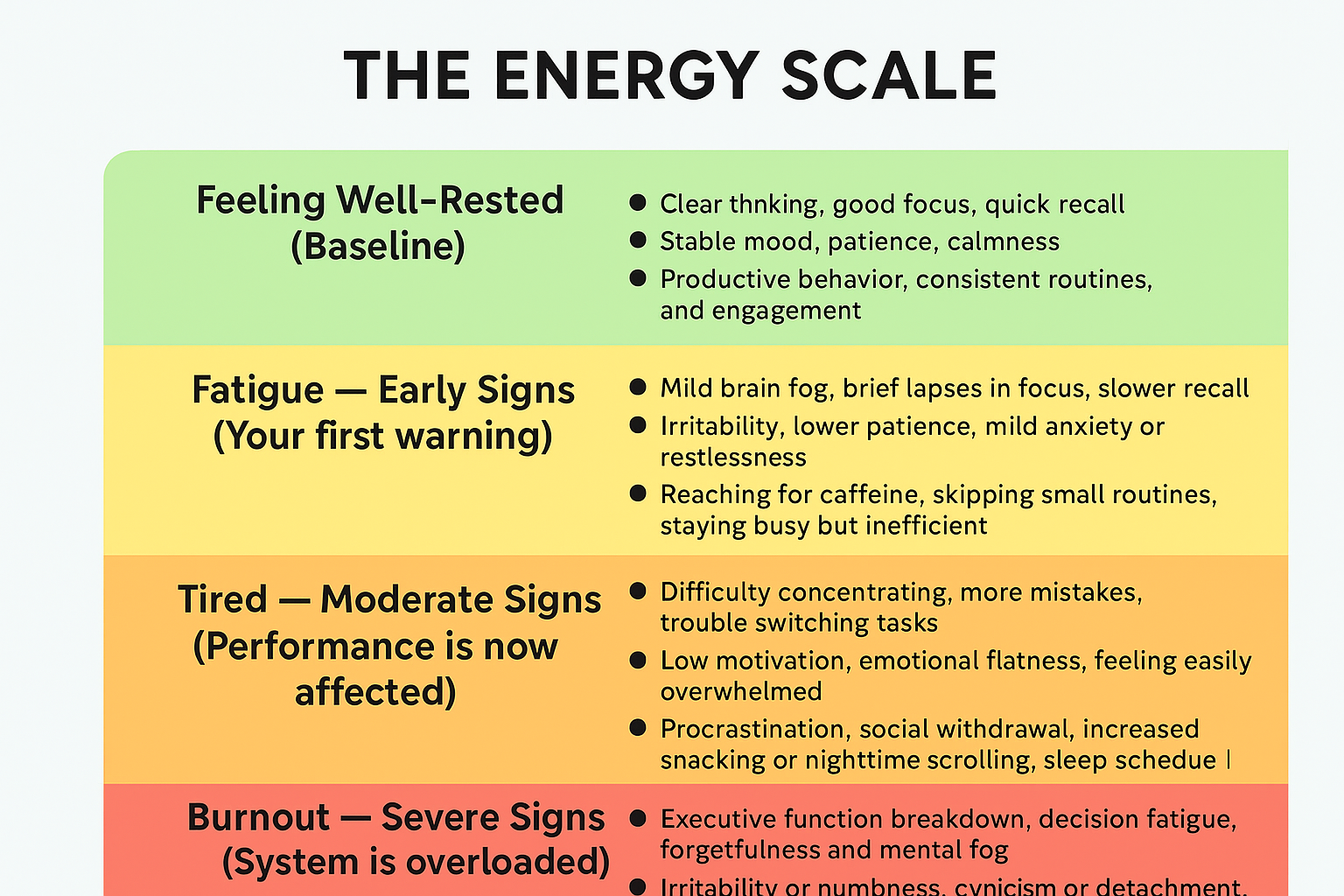
SLEEP
Sleep and rest are not a luxury for high-performers—it’s a cornerstone of sustained focus, productivity, and emotional regulation. Optimizing sleep goes beyond hours in bed; it’s about creating consistent routines, a supportive environment, and understanding the subtle factors that influence restorative rest.
Key Principles
Consistency over perfection matters most: a stable sleep/wake schedule strengthens circadian rhythm and improves recovery. Prioritize quality over quantity, because deep sleep and REM stages drive emotional regulation, memory consolidation, and physical repair. Nighttime sleep is irreplaceable; naps and NSDR sessions support recovery but cannot fully replicate the hormonal and neurological benefits of nighttime rest. Reduce evening stimulation by limiting screens, heavy meals, bright lights, and intense workouts before bed. Finally, supporting airway health is crucial—mild sleep apnea is common, often overlooked, and can significantly degrade sleep quality even in high-functioning adults.
Why Cooling Matters
Falling asleep requires a drop in core body temperature of 2–3°F (≈1°C). Warm environments can hinder this natural decline, leading to trouble falling asleep, fragmented rest, lower deep sleep, elevated nighttime heart rate, reduced HRV, and morning grogginess. Aim for a bedroom temperature of 60–67°F (15.5–19.5°C). Cooling strategies include keeping the room cool, using a fan or cracked window, taking a warm shower 60–90 minutes before bed to trigger the post-shower temperature drop, selecting breathable bedding, avoiding heavy pajamas, and moving intense workouts earlier in the day.
The Often-Missed Sleep Disruptor: Mild Sleep Apnea
Mild obstructive sleep apnea (OSA) affects roughly 1 in 6 adults, often without obvious symptoms. Even brief airway interruptions fragment sleep, reduce recovery hormones, increase next-day anxiety or irritability, impair focus and memory, elevate resting heart rate, lower HRV, and cause fatigue despite sufficient sleep hours. Common signs include unrefreshing sleep, snoring, morning headaches, frequent awakenings, gasping or choking at night, teeth grinding, daytime sleepiness, and elevated nighttime heart rate. High-risk individuals include those with stress, recent weight gain, larger neck circumference, back-sleepers, and those with chronic insomnia. Strategies to improve airway health include side-sleeping, limiting alcohol before bed, using nasal strips, reviewing sleep data, and consulting a physician for a home sleep test if symptoms persist.
Establishing a Simple Sleep Schedule
Anchor your day with a consistent wake time. Cool your environment to signal readiness for sleep, and follow a 30–60 minute wind-down routine that may include dimming lights, light stretching, reading, or NSDR. Set a bedtime 7–9 hours before waking and reduce evening stimulation. Morning sunlight within 30 minutes of waking reinforces your circadian rhythm.
Non-Sleep Deep Rest (NSDR)
NSDR is a powerful recovery tool that engages the parasympathetic nervous system, reduces sympathetic activation, and improves HRV. Studies show it enhances connectivity in brain networks related to attention, emotional regulation, and memory. Optimal sessions last 10–40 minutes; longer sessions may induce grogginess. Key elements include a quiet space, lying on your back with eyes closed, focusing on slow exhalations, and aiming to reduce cognitive load. Benefits include increased baseline dopamine, stress reduction, improved physical recovery, enhanced memory, and emotional regulation. NSDR complements, but does not replace, nighttime sleep.
Practical Steps & Homework
Complete one NSDR/Yoga Nidra session today (10–40 min)
Try NSDR during lunch or short work breaks
Set a consistent wake-up time every day for a week
Use a cooling strategy before bed tonight
Track changes in focus, energy, and sleep quality over 3–5 days
NSDR Resources
YouTube:
10–15 min: https://www.youtube.com/watch?v=6p_yaNFSYao
20–30 min: https://www.youtube.com/watch?v=1vx8iUvfyCY
Spotify: Search “Yoga Nidra” or “NSDR”